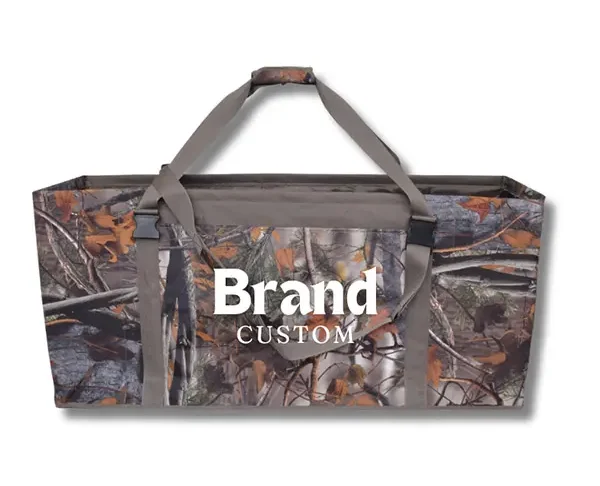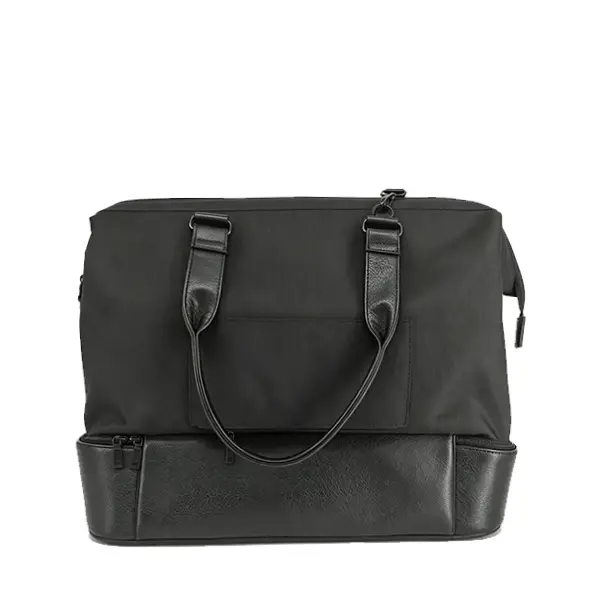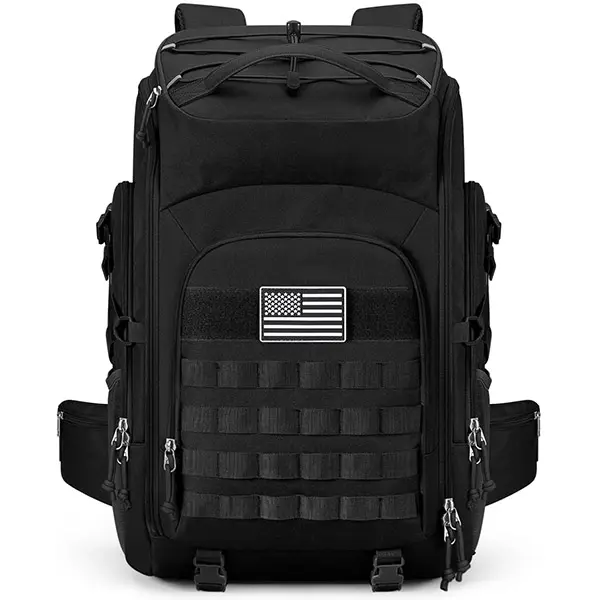
Polyester oxford is the default shell for most backpacks, duffels and totes, yet most specifications reduce it to one number. Three factories quote the same “600D” and come back 25 percent apart, because yarn tenacity, weave density, filament count and coating weight stay hidden behind the denier.
The difference is yarn size, and everything else follows. 600D is the lightest and most flexible at roughly 230 to 300 g/m², enough for commuter and promotional bags. 900D adds about 40 percent more abrasion life and 35 percent more tear strength for 60 to 100 g/m² of extra weight, the best value step on the ladder. 1680D is two 840D yarns plied in a 2×2 basket pattern, lands at 480 to 660 g/m², and is stiff enough that factories restrict it to base panels and high-wear zones.
The 600D vs 900D polyester debate only makes sense once you separate what denier measures from what it predicts.
What Do 600D, 900D and 1680D Actually Measure?
They measure the linear density of the yarn, not the weight or strength of the cloth. Denier is the mass in grams of 9,000 meters of yarn, so 600D means 600 grams over that length and 1680D means 1,680 grams. Fabric weight, abrasion and tear strength follow from that yarn size plus the weave and finish.
Denier Is Yarn Weight Over a Fixed Length
The number rises as yarn thickens, the opposite of cotton count systems where a higher figure means a finer yarn. This definition of linear density also explains the 1680D figure: two 840D bundles are plied, so the strand measures 1,680D without any single yarn being that heavy.
Why Denier Is Neither Fabric Weight nor Fabric Strength
Two fabrics labeled 600D can differ by 150 g/m² and 8,000 abrasion cycles. Three variables explain most of that spread:
- Filament count. A 600D yarn of 72 filaments is coarser and cheaper than the same denier at 144.
- Weave density. Oxford is quoted in picks per inch, and a tight 600D can beat a loose 900D on tear strength.
- Yarn tenacity. High-tenacity polyester shares a denier with standard yarn but not a breaking load.
How Coating Changes the Numbers More Than Denier Does
Coating often shifts performance more than denier does:
| Coating | Add-on | Hydrostatic head | Behavior |
|---|---|---|---|
| PU | 25 to 40 g/m² | 1,500 to 3,000 mm | Flexible, suits commuter and travel bags |
| PVC | 80 to 150 g/m² | 3,000 to 6,000 mm | Stiffer, can crack below minus 5 C |
| TPU | 30 to 60 g/m² | 5,000 to 10,000 mm | Flexible when cold, highest cost |
A 600D shell with a 40 g/m² PU coat beats an uncoated 900D on water resistance while staying lighter, which is why denier alone tells a factory almost nothing.
600D vs 900D vs 1680D: A Side-by-Side Comparison
A 600D vs 900D polyester comparison is not a choice between equals but a ladder. Each step buys durability and pays for it in weight, stiffness and cost.
| Property | 600D | 900D | 1680D |
|---|---|---|---|
| Weave | Plain | Plain or matte | 2×2 basket |
| Base weight | 230 to 300 g/m² | 300 to 350 g/m² | 480 to 560 g/m² |
| With PU coat | 250 to 340 g/m² | 330 to 400 g/m² | 560 to 660 g/m² |
| Martindale | 18,000 to 26,000 | 26,000 to 38,000 | 55,000 to 85,000 |
| Tongue tear | 220 to 320 N | 300 to 430 N | 520 to 760 N |
| Hand feel | Soft, folds flat | Firmer, holds shape | Stiff, board-like |
| Printing | Excellent | Good | Bold graphics only |
| Cost index | 1.0 | 1.3 | 2.0 to 2.4 |
| Typical use | Promotional, commuter | Work, outdoor, sports | Panels, luggage, tactical |
Weave density, filament count and coating move these figures by 15 to 25 percent either way, so treat the table as a planning tool, not an acceptance criterion.
600D Polyester, the Volume Workhorse
600D earns its place on flexibility rather than toughness. It folds flat, cuts cleanly, feeds evenly under a lockstitch machine and accepts screen print, heat transfer and embroidery. A shell on a 25-liter daypack adds roughly 250 to 320 grams. Its limits appear at contact points, where plain-weave 600D shows pile and color loss at the base long before the body looks worn, so most sports bag manufacturer programs add a heavier base panel.

900D Polyester, the Best-Value Upgrade
900D is the step most buyers underestimate. It delivers roughly 40 percent more abrasion life and 35 percent more tear strength than 600D for 60 to 100 g/m² of extra weight, because thicker yarns spread load across more filaments before any single one fails. Programmes built around hiking backpack manufacturer tooling treat 900D as the minimum for panels that contact rock, gravel or vehicle floors.
1680D Polyester, the Heavyweight Shell
1680D is a different class of cloth. Plied 840D yarns in a 2×2 basket weave give a dense surface, and the basket structure shares stress across two yarns at every intersection, which is why it tears at 520 to 760 N rather than 300 N. The construction descends from the anti-fragmentation jackets built for aircrews in World War II.
Three penalties come with it: it resists folding, so cartons bulk up; it dyes unevenly, limiting the color card to black and charcoal; and a full shell adds 300 to 450 grams over a 600D build, which is why travel bag manufacturer briefs reserve it for trolley edges and base panels.
Where 1200D Fits
1200D sits between 900D and 1680D in weight and price, and it suits buyers who want visible structure without a ballistic hand. It is not better than 900D in general terms: abrasion life keeps climbing above 1200D, but returns flatten while stiffness and sewing difficulty rise.
Which Is Better, 600D or 900D Polyester?
Neither is better in the abstract, and a supplier who answers without asking about load, service life and target price is guessing. In a 600D vs 900D polyester comparison, 600D wins where weight, print quality and unit cost dominate; 900D wins where the bag must survive daily contact with rough surfaces for two years or more
When 600D Is the Right Choice
- The bag carries under 8 kg and lives mostly indoors or in a vehicle.
- Artwork needs fine detail or full-color reproduction.
- Freight cost matters because the product ships folded in volume.
- Service life is one to two years, or the bag is a campaign giveaway.
When 900D Pays for Itself
- The bag contacts concrete, gravel, rock or truck beds in normal use.
- The product carries a warranty that a premature return would contradict.
- The shell transfers load through webbing anchors and compression straps.
- The customer judges quality by feel, as trade and outdoor buyers do.
| Bag type | Recommended shell | Reason |
|---|---|---|
| Promotional tote | 600D | Lowest cost, best print fidelity |
| Commuter daypack | 600D body, 900D base | Cost control with a wear-resistant base |
| Gym duffel | 600D or 900D | 900D where the bag is dragged on floors |
| Tool and equipment bag | 900D to 1680D | Abrasion and tear dominate the brief |
| Hiking pack | 900D body, 1680D base | Weight balance with a reinforced underside |
| Trolley luggage | 1680D panels | Dragged edges and airport handling |
Is 1680D Oxford Fabric Good?
Yes for the jobs it was designed for, and no as a default upgrade. It is the most abrasion-resistant polyester shell in mainstream bag production, with 55,000 to 85,000 Martindale cycles, but it is also heavy, stiff, hard to dye and roughly twice the fabric cost, so it belongs on base panels, trolley corners and tool bag wear zones.
Oxford, Ballistic and What the Labels Promise
Oxford describes a weave family, not a fiber: a plain or basket weave with a fine warp and heavier weft, usually back-coated. Ballistic describes a dense 2×2 basket built from high-denier plied yarn. The terms overlap and 1680D polyester is sold under both, so trust arithmetic: genuine 1680D weighs 480 to 560 g/m² uncoated and 560 to 660 g/m² coated, which makes a 320 g/m² roll a lighter fabric wearing a heavier name.

Where the Premium Is Justified, and Where It Is Not
The grade earns its cost where fabric is abraded under load: base panels set down on rock, trolley corners in airport handling, tool bags dragged across concrete. It does not earn its cost as a full shell on a daypack under 35 liters, where the weight penalty exceeds the gain. Nor does it improve waterproofing, since water enters through stitch holes and zip tape rather than the yarn.
What Is the Toughest Material for Backpacks?
There is no single toughest material, because abrasion, tear and cut resistance are separate properties and no fiber leads on all three. High-tenacity nylon 6,6 and 1680D ballistic polyester lead on abrasion and tear, ultra-high-molecular-weight polyethylene laminates lead on cut resistance.
| Material | Abrasion | Tear | Cut | Weight | Best use |
|---|---|---|---|---|---|
| 600D polyester | Moderate | Moderate | Low | Light | Volume bags, print-led products |
| 900D polyester | High | High | Low | Medium | Work, outdoor, sports |
| 1680D ballistic polyester | Very high | Very high | Low | Heavy | Base panels, luggage, tool bags |
| 1000D high-tenacity nylon 6,6 | Very high | Very high | Moderate | Medium | Tactical and expedition shells |
| UHMWPE laminate | High | Very high | Very high | Light | Anti-theft and cut-resistant zones |
Toughness depends on the failure being prevented: wear at a corner needs abrasion resistance, a running snag needs tear strength, and a blade needs a substrate no polyester weave provides. Nylon also beats polyester by 10 to 15 percent on abrasion and tear at identical construction, while polyester wins on UV stability and price.
How Denier Changes Manufacturing Cost, Weight and MOQ
Higher denier raises cost through four channels, not one: the fabric, the sewing time, the seam reinforcement and the freight paid on the finished carton. Buyers who budget only for fabric price are surprised by the other three.
Cutting, Sewing and Seam Bulk
A 1680D shell changes the sewing room, not just the invoice. Standard 600D runs on a 100/16 needle at 8 to 10 stitches per inch; heavy denier needs 110/18 to 130/21 needles, a walking-foot machine and slower throughput. Where a seam joins shell, foam and lining, the stack can reach 6 mm and cause needle deflection, which factories solve by skiving the inner layers back 6 to 8 mm.
Fabric Weight, Freight and Carton Economics
A 25-liter daypack needs roughly one square meter of shell. At 260 g/m² that is about 270 grams of fabric; at 600 g/m² it is about 630 grams. Across 40 pieces per carton, shipping weight rises by roughly 14 kg, which changes the freight calculation on every container.
Price Index and Minimum Order Reality
Fabric cost tracks the index above, with 900D at about 1.3 times the 600D price and 1680D at 2.0 to 2.4 times. Two constraints arrive with the heavier grades: dye lots are smaller because a tight weave takes up dye unevenly, and the fabric is stocked in fewer widths, which raises cutting waste on small panels. A factory that runs bag manufacturing services across several categories can often combine orders to reach a mill minimum.
How to Write a Denier Spec That Suppliers Cannot Misread
Name three numbers, not one: denier, target weight in g/m², and coating chemistry with add-on weight. Add the test methods and the tolerance you will accept, and the quotes you receive will describe the fabric you intend to buy.
- State the construction, for example 600D x 600D plain weave at 64 to 68 picks per inch.
- Give base and finished weight separately, with a tolerance of plus or minus 5 percent.
- Specify coating chemistry and weight, such as 30 g/m² PU plus a fluorocarbon-free DWR finish.
- Name the test methods and acceptance values for abrasion, tear, tensile and hydrostatic head.
- Require a sealed sample with the measured weight written on it as the bulk reference.
| Property | Method | What to accept |
|---|---|---|
| Grab tensile | ASTM D5034 | 600 N for 600D, 1,600 N for 1680D |
| Tongue tear | ASTM D2261 | 220 N for 600D, 520 N for 1680D |
| Abrasion | ASTM D3884 or D4966 | 20,000 cycles daily use, 60,000 heavy duty |
| Water penetration | AATCC 127 | 1,500 mm water resistant, 3,000 mm weatherproof |
Tear methods are not interchangeable between laboratories, and the tongue tear procedure is the practical reference when a mill and a buyer disagree about a roll, because it is used for acceptance testing of commercial shipments. A bare abrasion count is weaker evidence, since it says nothing about how the surface looked at a third of the cycles.
FAQ
Three details decide whether a denier choice survives production: the lining, the branding method and the care routine.
What denier should a bag lining be?
Lining is chosen for weight and cost, not abrasion, so it rarely matches the shell. A 210D to 300D polyester taffeta or light oxford at 60 to 120 g/m² is normal, with a light PU coat to stop fraying. Pairing a 1680D shell with a heavy lining adds grams and thickens every seam without improving durability.
Can high-denier polyester be printed or embroidered?
Screen printing works well on 600D and 900D because the plain weave presents a flat surface, though the ink deposit must be heavier than on apparel fabric. A 1680D basket weave breaks fine lines, so artwork needs simplifying to bold shapes. Embroidery on any coated shell punches holes through the water-resistant layer, so place the logo on an uncoated panel or behind a patch.
How should a PU-coated polyester bag be cleaned and re-proofed?
Brush off loose dirt, wash with mild detergent and a soft brush in lukewarm water, then rinse before it dries. Avoid solvents, chlorine bleach and machine washing, which attack the coating rather than the yarn. Air dry away from direct heat and never tumble dry hot, because sustained heat drives hydrolysis of the PU film. When water stops beading, apply a fluorocarbon-free spray repellent.