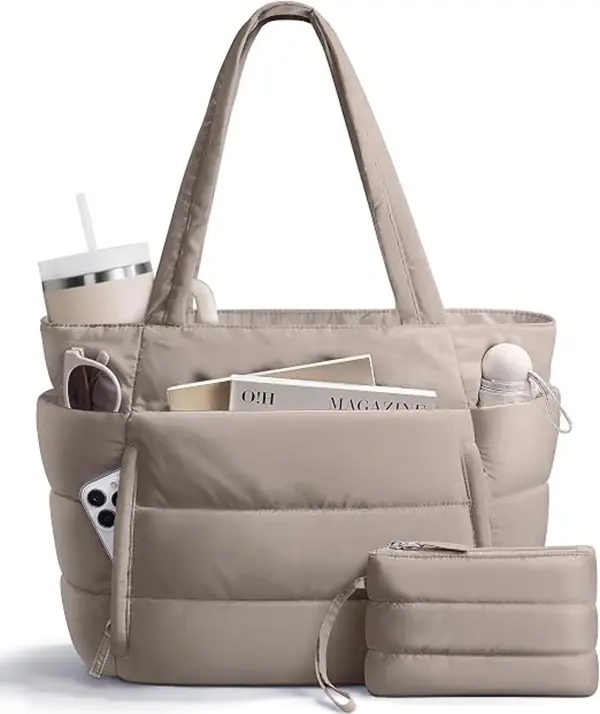
The puffer tote bag has moved from a seasonal novelty to a standing category in soft goods, and the buyers who order it now behave very differently from the ones who chased it three years ago. They ask about fill weight, quilt line density, shape recovery after carton compression and whether the shell survives a wash cycle. That shift is why so many custom programs stall at the quotation stage: not because the price is wrong, but because the specification behind it was never written down. Experienced travel bag manufacturers shorten that gap, but the buyer still has to arrive with decisions rather than adjectives.
A custom puffer tote bag is a three-layer construction, and every customization decision lands on one of those layers or on the stitching that holds them together: the shell sets the hand feel and weather resistance, the fill sets the loft and how long that loft lasts, and the lining plus internal build sets how usable the bag is once it is full. Quilting is not decoration applied afterwards; it is a structural operation that compresses the fill into panels, and it is usually the single largest driver of labour time and tooling cost in the whole order.
The sections below work through each decision in the order a purchase order usually meets them, from category logic to the tests that should be written into the contract.
Why the Puffer Tote Bag Category Is Still Expanding
The category is no longer driven by trend cycles but by replacement demand, which makes it safer to tool for than a fashion item and harder to differentiate within. Three terms get used interchangeably in sourcing conversations and should not be. Quilting describes the stitched pattern through a layered panel, padding describes the addition of a fill layer, and puffer describes the intent to reach visible volume. A bag can be quilted without padding, and padded without reading as a puffer, so the sample has to confirm look and usable interior space, not just a fabric swatch.
Are puffer tote bags still in style?
Yes, and the reason matters more than the verdict. Retail roundups through 2026 continue to place quilted and puffy totes at the top of the work-bag category, but the selling points have moved from silhouette to performance: light empty weight, water-repellent shells, a padded laptop sleeve and machine-washable claims. That is a replacement purchase profile, not an impulse one, so the commercial risk has shifted from the style going out of fashion to the product becoming indistinguishable from a dozen others at the same price.
Why do limited-edition totes sell out and resell above retail?
Limited drops from grocery and lifestyle retailers keep producing resale premiums, and the mechanics are reproducible. A low unit cost item with high perceived value, released in a visibly finite quantity and photographed well, creates scarcity unrelated to materials. The sourcing lesson is a capsule: 300 to 500 units across two or three colourways, one distinctive geometry, and a decision gate before scaling, which limits tooling exposure while testing whether the pattern sells.
What Can Be Customized on a Puffer Tote Bag
Six dimensions cover almost every puffer tote program: shell fabric, fill, quilting pattern, size and structure, branding method, and hardware plus packaging. Each carries a different cost profile. Buyers who treat them as one block often pay for flexibility they do not need and lose it where it mattered.
| Dimension | Typical options | What it changes |
| Shell fabric | 70D to 420D nylon, polyester, recycled variants, matte or gloss finish | Hand feel, abrasion life, packed volume |
| Fill | Polyester fibre, bonded wadding, foam, memory foam | Loft, weight, recovery after compression |
| Quilting | Diamond, channel, box, bubble, custom geometry | Labour time, tooling cost, visual identity |
| Size and structure | Open top, zip top, snap, reinforced base, laptop sleeve | Pattern consumption, carton cube, unit cost |
| Branding | Embroidery, rubber patch, woven label, metal plate, debossing | Minimum quantity per logo position |
| Hardware and packaging | Zipper type, pullers, dust bag, hangtag, polybag | Per-unit cost, retail readiness |
Colour sits outside that list, and buyers often assume it is free. Stock colours carry no surcharge; a custom dye lot adds a minimum quantity per shade and an approval step, so a four-colour launch is never linear in cost.
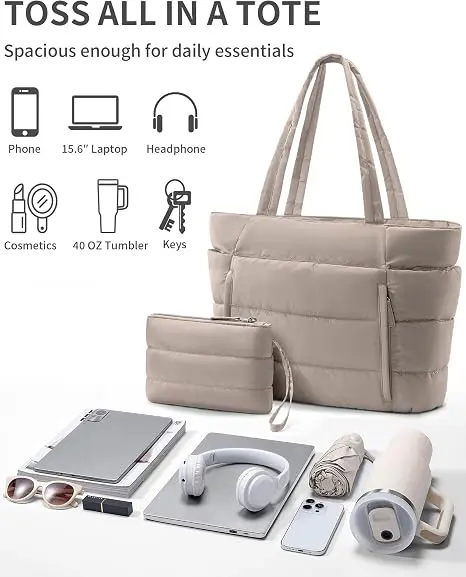
Which Shell, Fill and Internal Build Should You Specify
The shell decides how the bag feels in the hand, the fill decides whether it still looks like a puffer after a season, and the internal build decides whether anyone carries it twice. They should be agreed in one document, because changing the fill later forces the quilting program and often the panel dimensions to be redone.
Shell fabric by denier
Denier describes yarn weight per fixed length, so it tracks abrasion resistance and stiffness rather than quality. A 210D nylon drapes softly and quilts into a relaxed body. A 420D shell holds a crisper silhouette and resists scuffing at the base and handle roots, at the cost of a stiffer hand. A 70D high-density or ripstop nylon gives the lightest result and softest loft, but needs backing or a heavier lining to survive daily abrasion. Coatings and water-repellent finishes sit on top of that choice, and their durability under folding matters more than the initial spray rating.
Fill types and how they age
Loft is easy to achieve on day one and hard to keep. The table below reflects behaviour after repeated compression, which is the condition the bag actually lives in.
| Fill | Loft retention | Best suited to |
| Loose polyester fibre | Compresses and migrates within about six months of daily use | Entry price points, promotional volume |
| Bonded or spray-bonded wadding | Holds shape for several years, resists fibre migration | Mainstream retail programs |
| Expanded foam sheet | Firm, structured volume, slower recovery after packing | Structured silhouettes, device protection |
| Memory foam | Recovers slowly, feels dense and heavy | Premium positioning, small formats |
Internal organisation that stays invisible
Organisation has to be built so the exterior quilting runs uninterrupted. The usual solution is a padded sleeve against the back wall, cut from the same lining and stitched after the quilting is complete so that no seam crosses a quilt line. Two or three open pockets of graded depth go on the front interior wall for small items, a flat zip pocket goes on a side wall for valuables, and a light base board keeps a loaded bag from sagging into a sack. Brands that already sell a customizable commuting backpack usually reuse its pocket geometry here, which shortens sampling.
How Do Quilting Patterns Change Cost and Lead Time
Quilting pattern is a labour decision before it is an aesthetic one, because every stitch line is machine time and every new geometry is programming or tooling that has to be paid once. Two bags with identical shells and fills can differ by a third of their assembly cost on stitch density alone.
| Pattern | Programming or tooling | Effect on lead time and cost |
| Diamond | Standard cam or stored program | Baseline; the fastest common geometry |
| Vertical or horizontal channel | Stored program, wider spacing | Roughly 30 to 40 percent faster than diamond |
| Box or square grid | Stored program, tighter spacing | Baseline plus moderate stitch time |
| Bubble or offset rows | Stored program with alignment checks | Slightly above baseline; more handling |
| Custom geometry or lettering | One-time programming, typically USD 200 to 600 | 25 to 40 percent more labour, plus approval cycle |
Two constraints decide whether a pattern survives production. Stitch deviation should be held within about 2 mm so panels that meet at a seam still read as one continuous grid, and pattern scale has to be checked against the finished panel rather than the flat artwork, because the fill compresses the visible repeat once the panel is closed.
How Can You Create Your Own Custom Bag, Step by Step
Creating a custom puffer tote bag means converting a reference image into a measurable specification, approving it as a physical sample, and only then releasing bulk production. Skipping that step is the most common cause of a program that looks right in a rendering and wrong in a carton.
- Write a tech pack: finished dimensions with measuring points, capacity target, opening type and pocket layout.
- Fix the three layers: shell and coating, fill type and weight, lining and interlining.
- Approve the quilting geometry on a flat panel before any bag is assembled.
- Build the first sample and load it with the real contents, including a laptop in its own case.
- Test the stress points: handle roots, strap anchors, base seams and zipper ends.
- Confirm the branding method on the padded surface, not on a flat mockup, since padding changes stitch and emboss depth.
- Approve a pre-production sample, then run bulk with an agreed inspection level.
Acceptance benchmarks at the sample stage: a 15 kg static pull on the handle, 2,000 open-close cycles on the main zipper, seam strength of at least 80 N, and a 5 kg load left for four hours with the loft recovering once released.
How Much Does It Cost to Customize a Puffer Tote Bag
The cost of a custom puffer tote splits into per-unit variable cost and one-time tooling, and quoting them as a single number is what makes comparisons between suppliers meaningless. A higher sample fee with lower per-unit quilting time is often the cheaper program at volume, and the reverse is true for a capsule of a few hundred pieces.
| Cost element | Priced how | Amortised over |
| Shell fabric | Per metre, by denier and coating | Every unit, plus cutting waste |
| Fill | Per kilogram or per square metre | Every unit |
| Quilting labour | Machine minutes per panel | Every unit |
| Hardware and zipper | Per set | Every unit |
| Branding | Per position, with a minimum quantity | Every unit |
| Packaging | Per set | Every unit |
| Programming and tooling | One-time | The order, or the program life |
| Sampling | One-time, often credited | Deducted from bulk invoice |
Minimum order quantities for puffer totes commonly start between 100 and 500 units per design and colourway, with a meaningful price break around 500 pieces because fabric minimums and setup costs spread further. An OEM bag manufacturer should show that split in writing, since it is the only way to model a second order or a colour extension honestly.
Which Quality Checks and Documents Belong in the Purchase Order
Quality terms belong in the order document, not in a conversation after inspection, because most disputes about puffer totes are about measurement method rather than about defects. The checks below predict whether a puffer tote bag program ships clean.
- Surface wetting, measured by spray test rather than a marketing claim. ISO 4920 sets out the spray method for water-repellent finishes and deliberately does not predict rain penetration.
- Seam strength at handle roots, strap anchors and base corners, tested on the production fabric rather than a swatch.
- Handle and anchor fatigue under repeated dynamic load, not only a single static pull.
- Zipper cycling to the agreed count, with the puller and slider checked for alignment after the run.
- Colour fastness to rubbing and light, especially on dark shells where scuffing shows as a sheen.
- Dimensional tolerance stated flat or filled, since a puffer body measures differently in each state.
- Inspection level, usually AQL 2.5 under ISO 2859-1, with the defect classification written out.
- Certification chain for any recycled claim, which means a transaction certificate rather than a logo on a hangtag.
- Care labelling for the destination market; in the United States, the care labeling rule at 16 CFR Part 423 sets what must appear on the label and how it must be attached.
FAQ
Three questions come up after the specification is agreed, and each one affects either the sample or the freight plan.
Does a puffer tote bag keep its shape after washing?
Only if the fill was specified for it. Bonded wadding and foam recover well after a cold hand wash and air dry, while loose fibre tends to clump and migrate toward panel corners. Machine washing is safe only when the shell, lining and interlining are all rated for it and the quilting is dense enough to hold the fill in place. If washing is part of the retail promise, treat it as a test requirement rather than a care instruction, and use a proper how to clean a backpack routine for the hardware that wears first.
Can puffer totes be flat-packed to cut freight cost?
Yes, and most programs should plan for it. A medium puffer tote compresses to roughly a third of its filled height, which changes carton cube and therefore sea freight cost more than any material substitution. The trade-off is recovery: set a minimum rest time after unpacking, approve the bag as it looks straight from the carton, and confirm the quilting returns to its intended depth rather than staying creased along the folds.
Can one quilting pattern be reused across several sizes?
Usually yes, with limits. Stored programs can scale, but repeat and stitch density have to be recalculated when the panel size changes, or the grid drifts at the seams. Keep the repeat constant and let the panel crop it rather than stretching it to fit.