Short-haul flying has quietly turned into a hand-luggage economy. On many routes a checked bag now costs more than the seat itself, so travellers packing for two or three nights increasingly limit themselves to whatever fits above their head. That constraint leaves two realistic formats: a soft duffel bag and a small wheeled case, both sold in the same 40-litre class by most travel bag manufacturers, both accepted by the same airlines, and both capable of ruining a trip in different ways.
For a short flight of one to three nights, a duffel bag is the better choice when you are travelling light, moving through stairs, cobbled streets or multi-leg transit, and carrying clothes rather than fragile gear. A carry-on suitcase wins when the contents need structure: a laptop, formal wear, several pairs of shoes, or long terminal walks where you would rather roll than carry.
The comparison below works through capacity, weight, airline sizing and protection before settling on a recommendation by trip type.
Duffel Bag vs. Carry-On Suitcase at a Glance
Neither format is universally better, but they fail in opposite directions. A duffel bag gives you more usable space and more freedom of movement for less weight, while a carry-on suitcase gives you structure, protection and rolling. On flights under three hours with two or three nights of luggage, the duffel’s advantages usually outweigh its costs for leisure travellers.
The table below isolates the six variables that actually change the decision. Everything else, from colour to pocket count, is a preference rather than a trade-off.
| Dimension | Duffel bag | Carry-on suitcase |
| Empty weight | Typically 0.5-1.2 kg | Typically 2.2-3.5 kg |
| Usable space | Close to the full external volume | 10-20 percent lost to wheels and handle |
| Protection | Soft walls, contents exposed to impact | Rigid shell, contents held in shape |
| Movement | Carried on shoulder or back | Rolled on two or four wheels |
| Size compliance | Compresses, but bulges when overfilled | Fixed and easy to measure |
| Best for | One to three nights, casual trips, stairs | Business trips, formal wear, fragile items |
Capacity and Packing: Which Format Holds More?
At identical external dimensions, a duffel bag holds roughly 10 to 20 percent more than a carry-on suitcase, because wheels, telescopic handles and shell thickness consume volume that a soft bag uses for cargo. The advantage disappears the moment the bag is packed to its seams and starts bulging past the sizer.
This is the single most underrated difference between the two formats. A traveller comparing a 40-litre duffel with a 38-litre cabin case may assume the case is nearly as roomy, when in practice the case has a smaller opening, a divided interior and a wheel housing eating into one end.
Stated Litres vs. Usable Litres
Manufacturers calculate capacity from external dimensions, which means two bags with the same footprint can differ by several litres once hardware is subtracted. A soft bag can also be compressed when empty, so it squeezes into a tight overhead bin or a car boot that a rigid case would refuse. That flexibility only works while the bag is loosely packed. Overfill it and the soft walls become rigid, the zip takes the strain, and the shape stops being an advantage.
Why Organization Decides the Winner
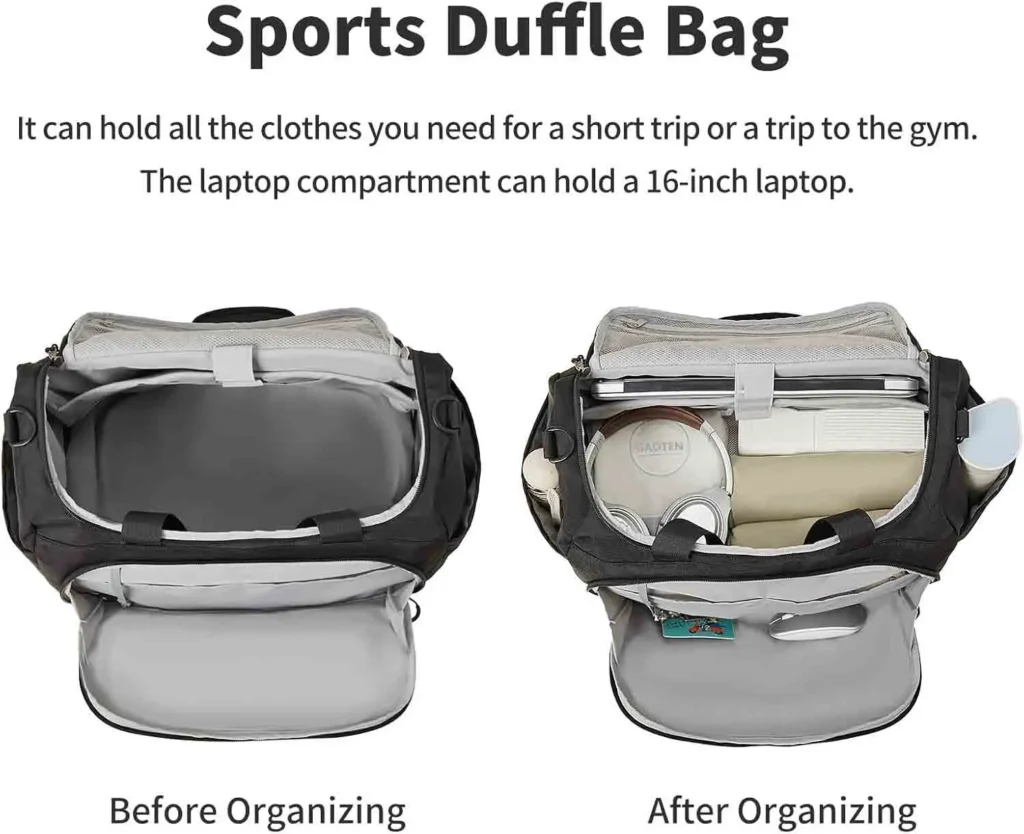
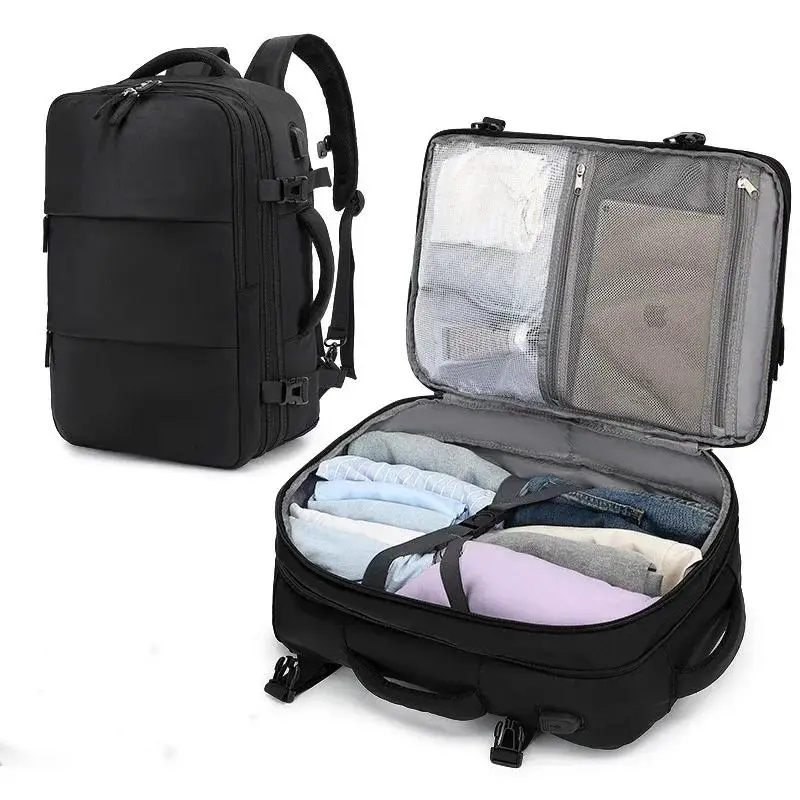
A duffel opens along the top, giving one deep compartment where everything is visible and nothing stays in place. A clamshell case opens into two flat halves with straps, dividers and a dedicated shoe pocket, which is why neat packers and over-packers both gravitate towards it. Compression travel packing cubes close most of that gap by turning a single cavity into four or five fixed blocks, and they also stop clothes from shifting on each handling. Wrinkles remain the case’s territory: shirts and trousers packed flat arrive smoother than the same garments rolled vertically.
Weight, Wheels and Real-World Mobility
A carry-on suitcase is easier for long, flat, indoor walks. A duffel bag is easier everywhere the surface stops being smooth. The practical tipping point is roughly fifteen minutes of continuous walking, or any staircase without a lift.
Empty weight matters more than most buyers expect. On carriers that cap cabin baggage at 7 to 10 kg, a 3 kg case has already spent a third of the allowance before a single item goes in, whereas a 0.8 kg duffel leaves room for a full trip. The trade is that every gram of that weight then sits on one shoulder.
Where Wheels Stop Paying Off
The rolling advantage is real but narrow, and it collapses in predictable places:
- Walk-up buildings without a lift, which are common in European city hotels.
- Cobblestones, gravel and broken pavements, where small wheels catch and vibrate.
- Boarding by external stairs on the apron, where the bag has to be lifted and carried anyway.
- Crowded overhead bins, where a soft bag deforms into a gap that a hard case cannot use.
- Trains, buses and metro turnstiles, where a duffel can be carried in front of the body.
Airline Size Rules: Is a Duffel Bag Small Enough for a Carry-On?
Yes, a duffel bag can be a legal carry-on as long as its packed dimensions stay inside the airline’s limit, which commonly sits near 55 x 40 x 20 cm or 56 x 45 x 25 cm including wheels, handles and side pockets. The risk is not the format itself but the overpacking that turns a compliant bag into an oversized one at the gate.
The IATA baggage rules note that many carriers apply a maximum near 56 x 45 x 25 cm and that those figures include wheels and handles, while each airline publishes its own allowance. That is why a bag which passed on one carrier can fail on another the following month, particularly on regional aircraft with smaller bins.
How to Measure a Soft Bag Before You Fly
Pack the bag the way you intend to travel, set it on the floor, then measure the widest point of each axis rather than the seam-to-seam panel. Handles, side pockets and a bulging zip all count. Leave 1-2 cm of tolerance, because a soft bag measured empty is not the bag the gate agent will see.
| Capacity | Typical packed dimensions | Carry-on verdict |
| 20-25 L | 45 x 28 x 22 cm | Fits personal-item limits on most carriers |
| 30-35 L | 50 x 30 x 25 cm | Fits standard cabin limits with margin |
| 40 L | 55 x 35 x 25 cm | Fits, provided it is not overfilled |
| 45-50 L | 60 x 35 x 30 cm | Usually exceeds length limits, check the fare |
Protection, Durability and What Cabin Crew Avoid
A hard-shell case protects what is inside it; a duffel bag protects itself. On a short carry-on trip, where the bag never enters the cargo hold, the duffel’s lower mass and flexibility tend to produce less damage than a rigid case, but it offers almost no defence for a laptop, a camera or a bottle.
The weak points of a soft bag are structural rather than cosmetic. Without a frame sheet the load shifts and the base sags, the zip becomes the only element holding the two halves together, and the bottom panel abrades against every kerb and luggage carousel it meets. A structured alternative such as front open hardside luggage holds its shape in a full bin and keeps a laptop isolated, at the cost of roughly two kilograms of empty weight.
The Two Suitcase Types Cabin Crew Advise Against
Cabin crew with long-haul experience have said publicly that they avoid two suitcase types: hard-shell cases used as checked baggage, because the shell can crack under the pressure of other bags in the hold, and four-wheel spinners, because a single failed wheel disables the whole bag. Both warnings concern checked luggage, yet the logic carries over to short flights. Fewer rigid failure points means fewer failures that end a trip, and that is precisely the argument for a soft bag carried on your shoulder. Crew also ask travellers to keep cabin bags light enough to lift into the bin unaided, which is easier with a duffel than with a packed case.
Which Bag Is Best for a 3-Day Trip?
For three days in mild weather, a 35 to 40 litre duffel bag covers most travellers: three tops, two bottoms, a light layer, toiletries and one spare pair of shoes fit without compression. Choose a 20-inch carry-on instead if the trip involves a dinner that needs a jacket, a second pair of shoes, or a laptop and its charger bag.
Three days is the length at which the duffel’s weaknesses have not yet appeared and its strengths are fully available. Beyond four nights the volume of clothing and the need to keep things organized start to favour the case.
| Trip length | Volume guide | Recommended format |
| One to two days | 20-25 L | Small duffel, often usable as a personal item |
| Three days | 35-40 L | Duffel bag with packing cubes |
| Four to five days | 40 L plus cubes | Duffel if casual, 20-inch case if formal |
| Five days and beyond | Over 45 L | Checked case or a duffel that is checked |
Overpacking for a short trip carries a specific cost. The UK Civil Aviation Authority points out that hand baggage sizes vary by airline and aircraft type, that some carriers will require oversized bags to travel in the hold, and that paying for that at the airport is considerably more expensive than buying the allowance in advance. A duffel packed to 45 litres for a three-day trip is exactly the bag that triggers this charge.
Who Should Choose Which?
Score three questions before buying: how far you will carry the bag on your body, whether the contents need protection from impact, and how many separate legs the trip involves. If two or more answers point the same way, the decision is already made.
Choose a duffel bag when:
- The trip is one to three nights and the itinerary is casual.
- Stairs, cobblestones, buses or trains feature in the route.
- The contents are clothing, and nothing fragile travels with you.
- The fare includes no checked bag and the cabin weight limit is tight.
Choose a carry-on suitcase when:
- A laptop, camera or bottles travel with you.
- Formal wear has to arrive unwrinkled.
- Terminal transfers are long and mostly indoors.
- The hotel room doubles as the wardrobe for the whole stay.
Hybrid Formats Worth Considering
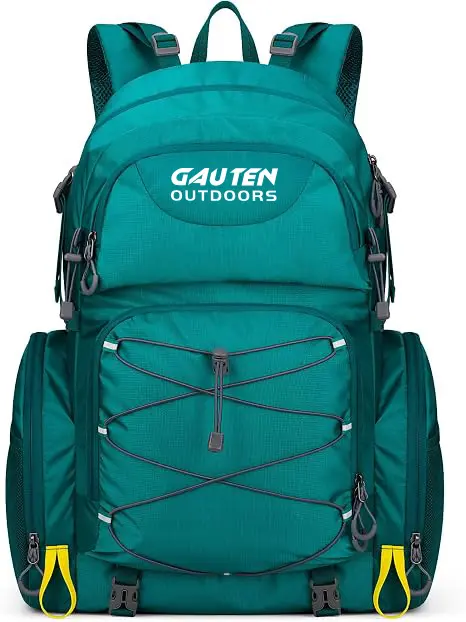
Two hybrids split the difference, with caveats. A duffel with stowable backpack straps is the most versatile option for one-bag travel, since it leaves both hands free and carries closer to the spine, but the harness adds 200-400 g and a poorly ventilated back panel becomes uncomfortable in heat. A wheeled duffel rolls like a case and opens like a duffel, yet the wheel assembly costs around a kilogram of empty weight and usually pushes the bag past cabin limits, which makes it a checked-bag format in practice.
For buyers specifying either format for a private-label range, the decision usually comes down to frame sheet stiffness, zip gauge and base abrasion resistance, which is where an OEM bag manufacturer adds the most value.
FAQ
Three questions come up repeatedly once the format is settled, and none of them is answered by the comparison above.
Can a duffel bag count as a personal item instead of a carry-on?
Usually yes, if it stays under the underseat limit, which most carriers set somewhere between 40 x 30 x 15 cm and 45 x 35 x 20 cm. A 20 to 25 litre duffel fits that envelope comfortably and slides under the seat more easily than a rigid case of the same volume, because the soft walls give way against the seat frame. The catch is that a personal item must remain flat enough not to block the floor space at your feet, so a half-empty bag that has collapsed sideways can be refused even when its measurements pass.
How do I stop a duffel from sagging when it is half full?
Give the bag something to push against. A removable frame sheet or a stiffened base holds the profile, compression straps pull the load towards the centre, and one packed cube placed at the far end acts as an internal wall. Packing heavy items along the base rather than at one end also stops the bag folding in the middle when it is lifted by a single handle.
Are soft bags more likely to be gate-checked than hard cases?
Not by material, but a bulging duffel looks larger than it measures and is harder to argue with at a sizer. The deciding factors are the published dimensions for your fare, the aircraft type and how full the flight is, and all three apply equally to rigid cases. The practical defence is the same for both formats: measure the packed bag at home, leave a centimetre of margin, and avoid the last-minute items that turn a compliant bag into a gate-check fee.