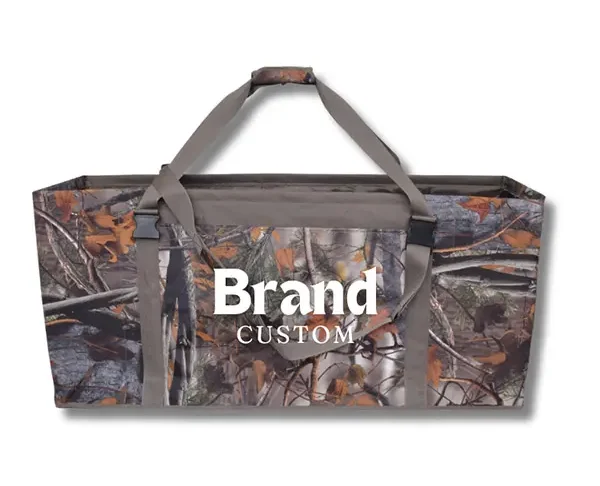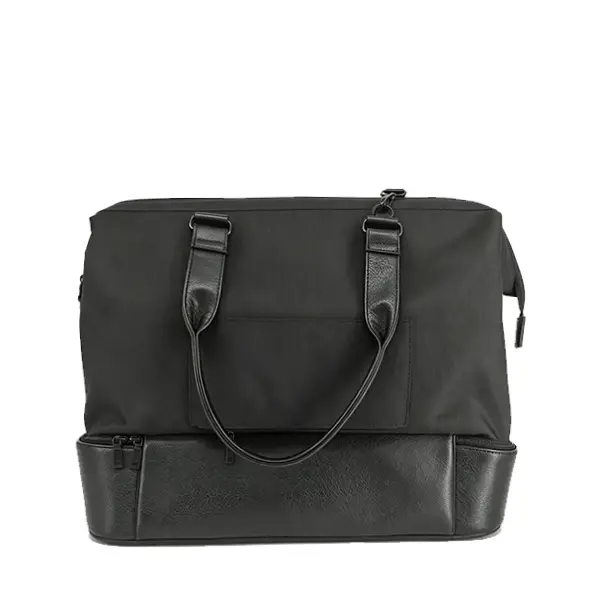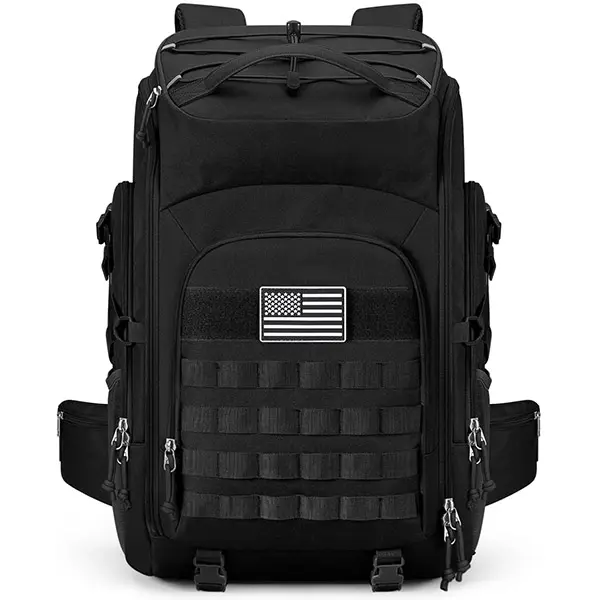
A sports duffel rarely fails at the face panel. It fails at the base that drags across a locker room floor, at the webbing anchors that take the full load on every lift, and at a main zipper that has been cycled a few thousand times in a season. Buyers comparing two quotations usually see the same words printed next to very different objects, and the denier number on the line above does not settle which one will survive a team season. Most programs settle that question with a sports bag manufacturer before the first sample is cut, because the fabric, the coating and the base panel have to be quoted together. Durability in this category is a materials question, but not a single-material answer.
The best material for durable sports duffel bags is a 600D to 1000D high-tenacity synthetic shell with a PU or TPU backing, a base panel one grade heavier than the body, and bar-tacked webbing at every anchor point. High-tenacity nylon wins on abrasion and tear per gram, 1680D ballistic nylon wins on puncture and cut resistance, and 600D polyester wins on cost per unit for volume programs.
What separates those three options is not the fiber name but the way weave, coating and seam construction behave together under load.
Which Fabrics Are Used in Durable Sports Duffel Bags?
Five fabric families cover almost every durable sports duffel on the market: 600D to 900D polyester, 1000D high-tenacity nylon, 1680D ballistic nylon, ripstop nylon, and TPU-coated tarpaulin. Each sits at a different point on the weight and cost curve, and none of them is the right answer for every program.
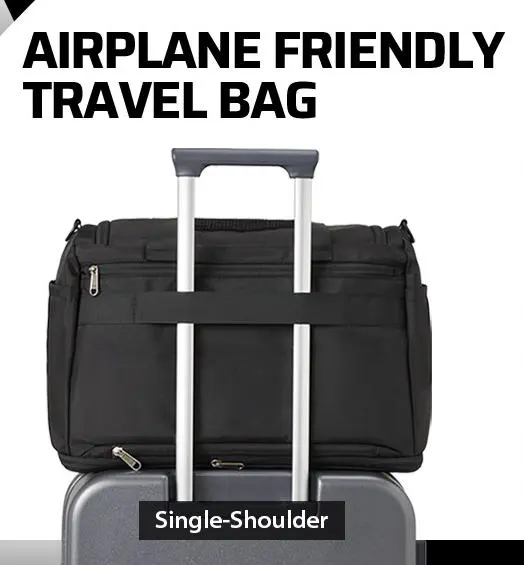
Ripstop and tarpaulin are often left out of buying conversations because they look like niche choices, yet they solve two problems the standard woven shell handles badly: packability at low weight, and a fully sealed barrier for wet sports. The table below places all five families on the same footing before the denier question is opened.
| Fabric family | Typical specification | Where it earns its place |
| Polyester | 600D to 900D, PU backed | Gym, school and team duffels in volume |
| High-tenacity nylon | 420D to 1000D | Premium travel and outdoor duffels, wear zones |
| Ballistic nylon | 1680D basketweave, about 500 g/m2 | Checked baggage, expedition and gear hauling |
| Ripstop nylon | 210D to 420D with a grid | Packable duffels and secondary bags |
| TPU-coated tarpaulin | 500D to 1000D base plus TPU film | Wet sports, boat and equipment bags |
Why Denier Alone Does Not Predict Durability
Denier measures the weight in grams of 9,000 meters of yarn, so it describes yarn thickness rather than the abrasion or tear resistance of the finished fabric. A textured 1000D yarn scuffs and sheds individual filaments while the weave underneath stays intact, which is why it can outlast a heavier 1680D shell with a smooth face; the smooth weave hides early wear, then fails faster once the surface breaks. ASTM D4157 defines the oscillating-cylinder abrasion method behind those cycle counts, and the standard deliberately sets no pass or fail figure, which is why two suppliers can both report abrasion results that are not comparable. Weave density, coating weight and finishing therefore rank above the denier printed on the spec sheet.
Nylon or Polyester: Which Is Better for a Sports Duffel Bag?
High-tenacity nylon is the better choice when a duffel has to resist abrasion, tearing and repeated loading, while polyester is the better choice when UV exposure, color retention and unit cost dominate. For team and gym programs the practical answer is usually a 600D polyester body with a heavier base, and nylon reserved for the base, corners and handle reinforcements.
Both fibers are hydrophobic synthetics and both accept a PU backing, so the decision turns on measurable differences rather than on how the fiber is marketed. Those differences show up fastest in wet conditions and in sun.
Strength, Abrasion and Wet Performance
Nylon carries higher tensile strength and greater elasticity, so it absorbs the shock of a dropped bag without the yarn breaking at the stitch line. Its moisture regain sits near 4 to 4.5 percent, and a fully soaked nylon shell can lose 10 to 15 percent of its breaking strength, which matters for wet sports and outdoor use. Polyester absorbs roughly 0.4 percent, keeps its dimensions when wet and dries quickly, so a soaked polyester duffel returns to its original shape while a nylon one may still be heavy the next morning.
UV, Color and Cost
Polyester resists UV degradation better and holds disperse dyes firmly, so black stays black through a summer of outdoor storage. Nylon fades sooner under direct sun and needs a higher grade of dyeing to hold deep shades. The trade-off is price: at equal denier, polyester is typically 20 to 30 percent cheaper per meter, and that gap is what makes a 900D polyester body viable where a 900D nylon body would break the target retail price.
| Property | High-tenacity nylon | Polyester |
| Abrasion resistance | Higher per gram | Moderate, adequate at 600D and above |
| Tear and tensile strength | Higher | Lower but predictable |
| Wet strength retention | Falls 10 to 15 percent when soaked | Nearly unaffected |
| UV and color fastness | Fades faster | Strong, especially in dark shades |
| Cost per meter | Higher | Typically 20 to 30 percent lower |
How Do Coatings and Finishes Decide Water Resistance and Lifespan?
The backing film and the seam treatment decide whether a duffel stays dry, not the shell fabric on its own. PU is the default for flexible sports duffels, PVC gives the heaviest barrier at the highest weight, and TPU suits welded construction with no solvent content. A DWR finish only makes water bead on the surface; it is not the barrier.
PU deserves a warning that rarely appears in a quotation. Polyurethane hydrolyzes in warm, humid storage, and peel strength between film and shell can fall to roughly a third of its original value after extended damp heat exposure, which is why duffels stored in a closed container through a wet season sometimes delaminate before they are ever used. Polyester adds a second trap: its smooth, low-energy surface bonds poorly to a PU film unless the shell is pretreated, and an untreated coating can flake away after a limited number of wash cycles. Neither problem is visible in a photo, and neither is caught by a fabric weight check.
| Backing | Weight and hand | Barrier strength | Watch point |
| PU | Light, flexible | Good | Hydrolysis in humid storage |
| PVC | Heavy, stiff | Excellent | Cold cracking, market restrictions |
| TPU | Light, elastic | Good, weldable | Higher film cost |
DWR and the backing are often confused in supplier sheets. DWR is a surface treatment that sheds rain, while the backing is the continuous layer that holds pressure; the measurable figure for the second is hydrostatic head, tested under ISO 811. A light rain duffel sits near 1,000 mm, while bike-packing and boat bags are typically specified at 5,000 mm and above. Whichever figure is quoted, the care routine decides how long it holds: the washing rules in this guide to how to clean a backpack apply unchanged to coated duffel shells, with no machine drying and no fabric softener.
Which Construction Details Matter More Than the Fabric?
The base panel, the handle anchors, the main zipper and the seam type all fail before the shell fabric does. A duffel is only as strong as the weakest of those four points, and each can be upgraded for a fraction of the cost of moving the whole bag up a denier grade.
A loaded duffel concentrates stress in ways a backpack does not: the handles carry the entire mass on every lift, and the base takes the whole bag’s weight plus impact every time it is set down. That is why experienced buyers specify the base independently of the body rather than paying for premium denier across the whole shell.
The inspection sequence below is the one worth running on a pre-production sample, in this order.
- Base panel and corners: one grade heavier than the body, double layer at the corners, optional PE board for shape.
- Handle and strap anchors: bar-tacked webbing, a reinforcement patch behind each anchor, wrapped grip on the hand carry.
- Main zipper: coil or molded tooth, grade 5 for gym bags and grade 8 to 10 for travel, double sliders where a lock is required.
- Seams: lock stitch at 8 to 10 stitches per inch, bound or taped seams on coated shells, no stitch line running through a load-bearing waterproof zone.
- Hardware: acetal or metal, matched to the rated load, with no plastic clip left as the weakest link on a shoulder strap.
What Is the Most Durable Duffel Bag Specification by Use Case?
The most durable duffel bag is not a fabric, it is a specification package matched to how the bag will travel. A gym duffel needs 600D polyester, a reinforced base and a vented shoe compartment; a checked-baggage duffel needs 1680D ballistic nylon, a double-layer base and a grade 10 zipper; a wet-sports duffel needs a welded TPU shell with no stitch perforations in the loaded area.
The same logic carries over to adjacent products, which is why one shell specification often serves a team duffel and a weekender or travel bag in the same range, with only the base and hardware upgraded between them.
| Use case | Body | Base and backing | Construction priority |
| Gym and studio | 600D polyester | Single layer, PU backing | Ventilation, shoe compartment |
| Team travel | 900D to 1000D polyester | One grade heavier, PU backing | Bar-tacked anchors, grade 8 zipper |
| Airline checked baggage | 1680D ballistic nylon | Double layer plus board | Grade 10 zipper, lockable sliders |
| Wet sports and marine | 1000D tarpaulin | Welded TPU, no stitch in load zone | Seam sealing, drainage |
Two acceptance tests make this specification enforceable rather than aspirational. Abrasion cycles should be run on production-weight fabric rather than mill swatches, and shell and seam strength should be measured by grab tensile under ASTM D5034, which can be written directly into a purchase order.
How Should Buyers Weigh Durability Against Weight and Unit Cost?
Cost per year of service is the number that matters, not the unit price. A shell upgrade that adds a few percent to the landed cost and doubles the replacement interval lowers real cost, while a heavier fabric that raises freight on every carton can quietly erase the gain.
Fabric weight compounds twice: once in the bill of materials and again in freight, because every carton of 20 duffels carries the difference. Moving a program from 600D to 900D adds roughly 100 to 150 grams per bag, which is 2 to 3 kilograms per carton and several tons across a container. That is affordable on a premium line and hard to justify on a promotional run where the bag is replaced annually anyway.
A defensible sourcing file therefore holds four test results rather than a fabric name.
- Abrasion cycles on production-weight samples, reported with the method and cycle count.
- Grab tensile on shell and on the seam, not on the shell alone.
- Hydrostatic head for any bag sold as water resistant.
- Color fastness and zipper cycling, since fading and zipper failure generate the returns that durability claims never mention.
Programs that need this level of documentation usually run it through a single OEM bag manufacturer that controls fabric sourcing, coating and stitching under one quality system, because splitting those three across suppliers is how a durable specification becomes an unverifiable claim.
FAQ
Three questions tend to arrive once the specification is on paper, and none of them is settled by the fabric name alone.
Are 1000D fabrics too heavy for a gym duffel?
For most gym programs, yes. A 1000D shell adds stiffness and empty-bag weight that a hand-carried duffel does not need, and the abrasion it prevents happens mostly on the floor, not on the body. A 600D body with a 1000D base and corners delivers most of the wear benefit at a lower weight and cost.
Does a heavier fabric raise shipping cost enough to matter?
On volume programs it does. A 2 to 3 kilogram increase per carton across a full container is a real freight line, and it is paid on every shipment rather than once. The calculation only favors the heavier shell when the replacement rate falls enough to offset it, which is worth modelling per program rather than assuming.
Can recycled polyester match virgin polyester durability?
At the same denier and with the same backing, recycled polyester delivers comparable abrasion and tensile performance, and it suits brands that need a documented recycled content story. The differences appear in color consistency between lots and in the certification chain, both of which should be checked on a sample before bulk rather than assumed from the yarn description.