A tote bag looks like the simplest product in a bag catalog: two panels, two handles, one print. That simplicity is why quotations for the same bag arrive at 1.50 USD and 4.50 USD. Nobody is overcharging; the two quotes describe different objects, with different fabric weights, decoration, and fixed costs spread over different quantities.
Manufacturing a basic cotton tote bag costs roughly 0.50 to 2.00 USD per unit in bulk, a standard 10 ounce canvas tote with one color screen printing lands near 2.00 to 3.00 USD at 500 pieces, and premium 14 to 16 ounce bags with multi color decoration and retail packaging run 5.00 to 12.00 USD. Those are ex-works or FOB prices, and landed cost adds another 25 to 40 percent on a small order.
The sections below break that range into its components, show how specification and quantity move the number, and explain what a first order pays that never appears in the unit price.
What a Tote Bag Costs to Manufacture
A buyer needs a range rather than a price, because three inputs set it: fabric weight, decoration, and order volume. The reference point most factories quote against is a 10 ounce canvas tote, one color print on one side, at 500 pieces.
Fabric choice is a weight decision as much as a fiber decision: the same pattern consumes nearly three times the cotton at 12 ounces as at 4, and heavier fabric sews more slowly, so material and labor rise together.
Price bands by material and weight
| Material | Typical weight | Indicative FOB at 500 pieces | What it suits |
| Non-woven polypropylene | 80 to 100 gsm | 0.50 to 2.00 USD | Event giveaways, short life |
| Jute | 270 to 300 gsm | 1.50 to 4.00 USD | Eco positioning, grocery |
| Cotton, light | 6 to 8 oz | 2.00 to 4.00 USD | Promotional, retail carry |
| Cotton canvas | 10 to 12 oz | 3.00 to 6.00 USD | Daily use, retail programs |
| Organic cotton canvas | 10 oz | 4.00 to 8.00 USD | Certified organic claims |
| Heavy canvas | 14 to 16 oz | 5.00 to 10.00 USD | Premium, structured, gift |
| Recycled polyester | 300D | 2.50 to 6.00 USD | Technical look, sublimation |
A worked build-up at 500, 1,000 and 2,000 pieces
Component pricing is more useful than a total, because it shows which lines respond to volume and which do not.
| Cost element | 500 pcs | 1,000 pcs | 2,000 pcs | Share at 500 |
| Canvas and lining pocket | 1.25 | 1.18 | 1.12 | 35 percent |
| Webbing handles and attachment | 0.62 | 0.57 | 0.53 | 17 percent |
| Cut and sew labor | 0.95 | 0.87 | 0.81 | 26 percent |
| Print setup, amortized | 0.25 | 0.13 | 0.06 | 7 percent |
| Labels, polybag, packing | 0.28 | 0.21 | 0.17 | 8 percent |
| QC and overhead allocation | 0.25 | 0.19 | 0.15 | 7 percent |
| Indicative FOB unit | 3.60 | 3.15 | 2.84 | 100 percent |
Fabric and labor account for 61 percent of the 500 piece price and barely move with volume. Print setup is 7 percent and halves with every doubling, which is why the saving between 500 and 2,000 pieces reaches only about 0.76 USD per bag.
The Five Cost Blocks Inside Every Quote
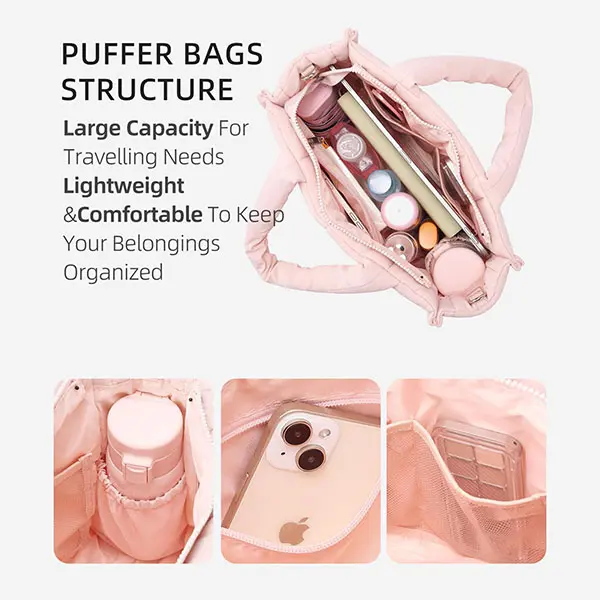
Every quotation is built from five blocks: material 30 to 50 percent, labor 20 to 30, decoration and setup 10 to 25, hardware, labels and packaging 10 to 20, and overhead with margin 10 to 15. A quote that cannot be split this way cannot be compared.
Material and fabric consumption
Fabric is priced by weight and width, and the pattern decides how much of the roll is used. A gusseted body needs a wider panel, a lined bag doubles the panel fabric, and cutting waste of 3 to 8 percent is normal, so ask for consumption per bag in square meters.
Cut and sew labor
An open top tote takes roughly 12 to 20 minutes on a line. Adding a pocket, a zipper, a reinforced base, and bound seams pushes the same bag past 35 minutes, doubling labor before any material is added, which is why two factories quote one drawing differently.
Decoration and its setup
Screen printing is cheapest at volume but carries a screen charge of 30 to 60 USD per color, plus 0.50 to 1.00 USD per bag for a one color print. Digital printing removes the setup and adds 3.00 to 6.00 USD per bag, which wins below 300 pieces and loses above 1,000. A factory running full bag manufacturing services cuts, prints, and packs under one roof, removing a handling step and a week of transit.
Hardware, labels and packaging
Each feature is a line item: zipper 0.50 to 1.00 USD, snap 0.25 to 0.50, woven label 0.15 to 0.40, hangtag 0.10 to 0.25, polybag 0.05 to 0.20, retail box 0.30 to 0.80. On a 2,000 piece order these small lines can add more than the fabric upgrade.
Overhead, QC and factory margin
Utilities, supervision, sampling rooms, inspection staff, and financing sit at 8 to 12 percent of price before margin. A quote without overhead is not cheaper; it returns as a surcharge.

Why the Same Bag Is Quoted at 1.50 and 4.50
The gap is specification rather than supplier honesty. Two bags that look identical in a photograph can differ in fabric weight, gusset, lining, handle attachment, color count, and packaging, and each difference has a known price.
| Specification change | Typical addition per unit |
| 4 oz cotton to 10 oz canvas | 0.80 to 1.50 USD |
| Flat body to 4 inch gusset | 0.25 to 0.50 USD |
| Unlined to lined body | 0.40 to 0.90 USD |
| Single stitch to box-X handle attachment | 0.10 to 0.25 USD |
| One print color to four colors | 1.00 to 2.00 USD plus setup |
| Open top to zipper closure | 0.50 to 1.00 USD |
| Polybag to printed retail box | 0.30 to 0.80 USD |
| No branding to woven label and hangtag | 0.25 to 0.60 USD |
A quote that looks 40 percent cheaper is usually two lines down this table, not one. Send every supplier the same specification sheet and require written confirmation of weight, gusset depth, lining, handle length, stitch type, color count, and packing.
What a luxury tote costs to make
A high end tote sits at a different point on the same curve. Coated canvas or leather pushes material to 15 to 40 USD per bag, custom hardware adds 1,500 to 6,000 USD in tooling, and construction can reach 60 to 120 minutes. Manufacturing typically lands at 10 to 20 percent of retail, with the rest paying for design, marketing, and the brand.
How Quantity Changes the Unit Price
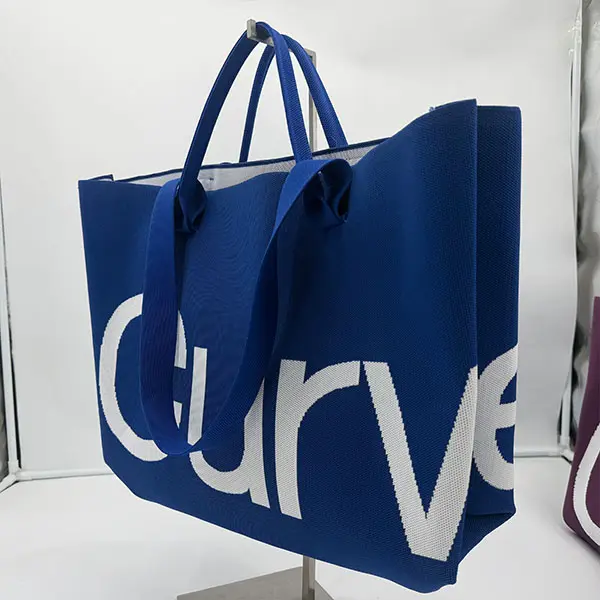
Doubling quantity does not halve the price. Between 100 and 1,000 pieces the unit price usually falls 40 to 50 percent, between 1,000 and 5,000 pieces another 15 to 25 percent, and beyond that the curve flattens because variable costs dominate.
| Quantity | Indicative unit price, 10 oz canvas, one color |
| 100 pieces | 4.50 to 5.50 USD |
| 500 pieces | 3.00 to 3.60 USD |
| 1,000 pieces | 2.60 to 3.10 USD |
| 5,000 pieces | 2.10 to 2.50 USD |
| 10,000 pieces | 1.90 to 2.30 USD |
Where the savings stop
Fixed costs bend the curve: a 300 USD screen charge is 0.60 USD per bag over 500 pieces and 0.15 over 2,000, and no negotiation changes that arithmetic. Once setup is diluted, fabric, labor, and freight remain, and fabric has a floor set by the cotton market.
That is why consolidating beats splitting: 1,000 bags in one run usually costs less per unit than 500 plus 300, and moving from 500 to 1,000 commits an extra 1,575 USD to save about 0.45 USD per bag, which only pays if the bags sell.
The Costs You Pay Before the First Bag Ships
First orders carry fixed costs that never appear in the unit price. Sampling, screens, pattern development, compliance testing, tooling, and freight minimums commonly add 300 to 1,500 USD to a first run of 500 bags.
- Pre-production sample: 50 to 300 USD, often credited against the bulk order.
- Screens or plates: 30 to 60 USD per color, per design.
- Pattern development or grading: 50 to 150 USD for a new shape.
- Embroidery digitising: 25 to 60 USD per logo.
- Custom die for a hangtag or foil stamp: 80 to 250 USD.
- Restricted substance testing: 150 to 500 USD per style, as described under the OEKO-TEX STANDARD 100 criteria for harmful substances.
- Injection molded hardware: 1,500 to 6,000 USD, rarely justified on a tote.
- Freight minimum, documents, and inspection: 150 to 400 USD on a small shipment.
A capable OEM bag manufacturer lists these separately and states which are one-time, which are credited back, and which repeat on a reorder. A supplier who folds them into a unit price makes comparison impossible.

From FOB to Landed Cost
FOB covers the bag at the origin port and nothing after it. Freight, duty, clearance, and inland delivery add 25 to 40 percent on a small order and 8 to 15 percent at container volume.
The four additions
Sea freight is cheapest per unit and slowest, and its per bag cost depends on how well cartons fill a container: 100 to 150 folded totes per carton, 25,000 to 30,000 units in a 20 foot container. Air and express add 1.00 to 2.00 USD per bag on small shipments, often more than the labor line. Duty falls between 5 and 18 percent of customs value by fiber and destination, and clearance adds a fixed 100 to 250 USD per shipment.
A worked landed example
A 3.00 USD FOB bag can arrive at 5.90 USD: 0.60 freight, 0.55 duty at 12 percent, 0.25 clearance, and 0.25 inland delivery. On 300 units shipped by air the same tote bag can pass 6.50 USD, which is why a domestic printer quoting 5.50 USD sometimes beats an overseas factory quoting 3.00. Landed cost, not FOB, belongs in the pricing model.
Labor Cost and Where the Bag Is Made
Labor is minutes multiplied by hourly rate. A 20 minute tote costs about 1.17 USD to sew where the rate is 3.50 USD per hour, and about 4.00 USD where the rate is 12.00 USD, before a metre of fabric is bought.
| Production region | Typical hourly rate | Labor on a 20 minute bag | What the premium buys |
| China, Vietnam | 3.50 to 5.00 USD | 1.17 to 1.67 USD | Lowest FOB, 30 to 45 day lead time |
| Eastern Europe | 6.00 to 9.00 USD | 2.00 to 3.00 USD | Shorter freight to the EU |
| United States | 12.00 to 25.00 USD | 4.00 to 8.30 USD | Days not weeks, no duty, small runs |
Differences of this size are documented at national level by ILOSTAT, which publishes manufacturing earnings and labor cost data by country. The gap reflects productivity and cut and sew capacity rather than a temporary arbitrage, and it explains why one specification quotes three times higher in one country than another.
Is the Tote Bag Business Profitable?
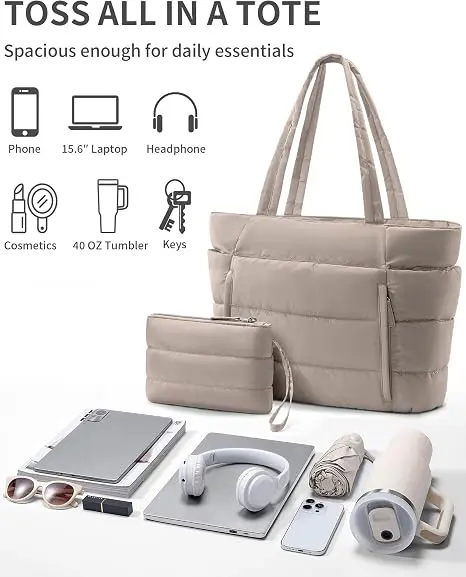
Yes, at the right specification and price. A 500 piece run landing near 4.00 USD per bag supports roughly 55 to 65 percent gross margin sold direct and 25 to 40 percent wholesale, provided the bag is priced for its channel rather than marked up from cost.
Unit economics on a 500 piece run
Take a 10 ounce canvas tote landing at 4.05 USD with a two color print. Sold direct at 14.00 USD, after fees, shipping, and returns at roughly 30 percent, contribution is about 5.75 USD per bag. Sold wholesale at 7.50 USD the margin is 3.45 USD with no fulfilment cost. A first run covering 2,000 USD of setup breaks even at roughly 350 units sold direct, which is why test quantity matters more than perfect pricing.
What handmade totes sell for
Handmade totes typically sell between 15 and 45 USD, and the price is set by hours rather than fabric. Two hours at 15 USD per hour costs 30 USD before materials, so handmade work cannot compete on unit price and should not try; it competes on design, small batches, and personalization.
Cost per use
Dividing landed cost by the number of carries changes the comparison. A 4.00 USD canvas tote used 100 times costs 0.04 USD per use; a 1.50 USD non-woven bag used eight times costs 0.19. Recycled and certified fibers add 15 to 25 percent to material cost, and the Textile Exchange materials data tracks how fast that supply is shifting. If the bag ships with a pouch, quote the pieces together, since a supplier already running cosmetic bag manufacturer programs can share fabric, setup, and freight.
How to Start a Tote Bag Business Without Overpaying
Start with a specification and a landed cost model, not a logo. The sequence that keeps a first order solvent is niche, specification, sample, small run, landed cost, price, then reorder.
- Choose a niche and a retail price first, because price decides which fabric weight is viable.
- Write a specification sheet with dimensions, weight, handle drop, stitch type, print size, and packing.
- Order one sample and measure it against the sheet rather than judging it by eye.
- Run 100 to 300 pieces through a trade printer or small factory before a custom pattern.
- Build landed cost with freight, duty, and inspection, not just FOB.
- Reorder the specification that sold, not the one that looked best in a mockup.
Three moves waste money predictably: paying for tooling before sell-through, approving artwork without a dieline, and skipping the sealed sample to save two weeks. When the first order ships, a conversation with a bag manufacturer about reorder timing and fabric reservation is worth more than another price negotiation.
Frequently Asked Questions
Will the sample fee be credited against my order?
Usually in full or in part, but only if agreed in writing before sampling. Ask whether the credit applies to bulk, whether it expires, and whether a second sample is charged again.
Why does an online calculator quote less than my factory?
Calculators assume a stock body, one print color, standard packing, and no freight or duty. Use them to set a floor, not a budget. Compare only quotes that state weight, decoration, packing, and Incoterm.
Can I mix colors and styles in one order?
Yes, but minimums normally apply per color and per style, so four colorways at 150 pieces can mean 600 units. Sharing fabric and handles across styles reduces the penalty, and combined packing lowers freight. Expect a sorting fee if cartons must be separated by store.