Almost every soft-sided travel bag sold today is built from one of two synthetic shells, and most buying decisions start and end with the fabric name on the hangtag. That single word carries a lot of assumptions about toughness, weather resistance and price, yet the same word can describe a 210 denier ripstop shell and a 1000 denier ballistic weave that behave nothing alike. For brands sourcing a range, and for travellers comparing two bags on a shelf, the fibre question is worth answering properly rather than by habit.
Both nylon and polyester make serviceable travel bags, and neither wins across the board. At the same yarn weight nylon resists abrasion and tearing better and feels softer in hand, while polyester absorbs almost no water, dries faster, holds colour under sunlight and costs less per unit. The right choice depends on how the bag is carried, where it travels and what the buyer can pay for the shell.
This guide compares the two fibre families on the measures that decide how a travel bag performs in service, then turns those measures into specification decisions.
Nylon vs Polyester Travel Bags at a Glance
At equal fabric weight nylon leads on abrasion and tear strength, while polyester leads on moisture management, UV stability and landed cost. Most travel bag failures trace back to denier, coating and seam construction rather than to the fibre name printed on the label.
The comparison below sets both materials against the variables that decide how a travel bag holds up in warranty claims and return data.
| Metric | Nylon | Polyester |
| Abrasion at equal denier | Higher | Lower |
| Moisture regain | 4% to 8% | About 0.4% |
| UV and colour fastness | Moderate | Strong |
| Weight at equal strength | Lighter | Heavier |
| Hand feel | Smooth, cool | Crisp, matte |
| Relative unit cost | Higher | Lower |
| Typical denier for travel bags | 210D to 1000D | 600D to 900D |
| Best fit | Carry-on, outdoor use | Checked bags, volume lines |
Read the table as a set of trade-offs rather than a scoreboard. A shell can lead on every row that matters for one programme and lose on the row that decides margin for another.
What Is the Real Difference Between Nylon and Polyester?
Nylon is a polyamide and polyester is polyethylene terephthalate, so the two sit in different polymer families. That backbone decides how each fibre takes dye, absorbs moisture and responds to heat, which means the differences downstream are structural rather than cosmetic.
Nylon, a polyamide first commercialised in the 1930s, is built from amide linkages that form hydrogen bonds between chains. Those bonds give it high tensile strength, useful elasticity and a smooth, cool hand feel. Polyester, or polyethylene terephthalate, packs stiffer aromatic chains into a denser structure at roughly 1.38 g/cm3 against nylon’s 1.14 g/cm3, so an equal length of each does not weigh the same.
Dyeing follows the same logic. Nylon takes acid dyes easily but holds colour near the surface, while polyester locks disperse dyes inside the fibre.
Why the Fiber Family Matters More Than the Label
Both names cover a wide specification span. Nylon shells range from 210D ripstop to 1000D weaves, and polyester from 300D pack cloth to 900D oxford, each available uncoated, PU-backed or film-laminated. A 210D uncoated nylon shell and a 600D PU-backed polyester shell are not competitors, even though both are sold as fabric travel bags.
That spread matters when one product line spans several item types. Both fibres appear across a complete travel accessories range, from packing cubes to laundry sacks, and each item in a travel bag line deserves its own specification rather than an inherited one.
How Do the Two Materials Compare on Durability?
At the same denier nylon is the tougher shell. It resists abrasion and tearing better, stretches before it fails and recovers its shape, which is why heavy-load travel bags default to it. Polyester closes most of the gap once the specification moves to a higher denier.
Durability arguments often rest on one test number, but abrasion, tear and elongation behave differently, and a shell can be strong in one and weak in another.
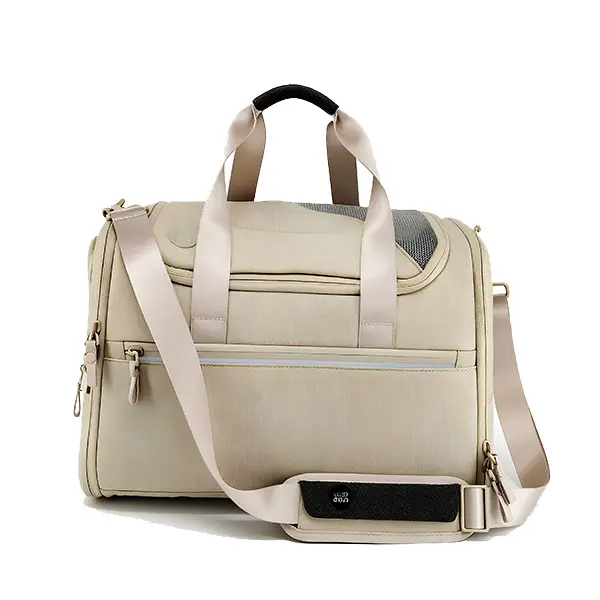
Abrasion, Tear and Elongation
In rotary drum abrasion testing at comparable fabric weights, nylon survives roughly 20% more cycles before surface breakdown, with visible wear from about 5,000 cycles against 3,500 for polyester. Elongation at break runs 30% to 40% against 15% to 25%, so nylon deforms and springs back under a sharp load while polyester passes that load into the seams.
Surface behaviour cuts the other way. Nylon pills and frays at cut edges, which is why bound seams and heat-cut panels matter on nylon programmes. Polyester keeps a cleaner face but dislikes repeated folding in the cold.
Why Denier Alone Does Not Tell the Story
Denier measures the mass in grams of 9,000 metres of yarn, so a higher number means a thicker yarn, not automatically a tougher travel bag. Because the polymers differ in density, 600D nylon and 600D polyester are not the same amount of material, and comparing them as equals flatters one side.
| Specification | What it tells you |
| Denier | Yarn thickness before weaving |
| Fabric weight in gsm | Total mass including coating |
| Coating type and add-on | Water resistance and flex life |
| Bar-tack at stress points | Whether shell strength reaches the seams |
Which Material Handles Water, Humidity and Sunlight Better?
Polyester is the more stable fibre in wet and sunny conditions. It absorbs roughly 0.4% of its weight in water, dries quickly and keeps both strength and colour under UV. Nylon takes on 4% to 8%, loses about 10% of its strength while damp and yellows in prolonged sun, although it recovers fully once dry.
Water performance is the row buyers misread most often, because fibre and finish are separate decisions.
Water Absorption, Drying and Coating
Uncoated nylon is not waterproof, and neither is uncoated polyester. What differs is how much water the yarn holds. A soaked nylon travel bag gains noticeable weight and stays damp for hours, which on a tropical itinerary means mildew risk and odour by day three. Polyester sheds surface water and returns to dry weight quickly.
Coating decides the real hydrostatic performance. A PU backer reaches roughly 1,500 to 2,500 mm of water column while staying supple through repeated folding, PVC pushes higher but stiffens and cracks in the cold, and a TPU film gives the best flex life at a higher cost. Drying behaviour also shapes care, which is why the routines in this guide on how to clean a backpack differ by fibre and coating.
UV Degradation and Color Fastness
After extended sun exposure polyester retains 10% to 15% more of its strength than nylon. Left outdoors for six months, a nylon shell can lose around 40% of its abrasion resistance against roughly 15% for polyester, and pale nylon shades shift toward yellow as the surface oxidises.
For a travel bag that lives in a vehicle boot, on a roof rack or in a shop window, that gap is more decisive than any abrasion figure.
Which Material Is Best for a Travel Bag?
There is no single best material. A soft carry-on that travels every week is better served by nylon, while a checked duffel or a high-volume promotional line is better served by polyester. What decides quality is how fibre, denier and coating are matched to the way the bag is handled.
The table below converts the trade-offs into build recommendations for each travel bag use case.
| Use case | Recommended build |
| Weekly carry-on, soft duffel | 420D to 500D nylon, PU backer |
| Checked baggage, heavy abuse | 800D to 1000D nylon, reinforced base |
| Business and urban carry | 600D polyester, matte finish |
| Outdoor and expedition | 500D nylon or above, TPU laminate |
| Humid and tropical climates | 600D polyester, mesh ventilation |
| Promotional and volume retail | 600D polyester, single-colour print |
Two bags built to the same fabric brief can still differ in service life once hardware enters the picture. A metal toothed main zipper, bar-tacked handle anchors and a doubled base panel do more for durability than moving one step up in denier, which is why a well-built travel bag range usually mixes both fibres and upgrades the fittings instead.
Is Nylon as Bad as Polyester for Microplastics?
No. Fibre chemistry is one variable among several, and construction and finishing matter more. In controlled washing tests, mechanically treated polyester shed roughly six times more microfibre mass than woven nylon, but cotton and wool shed heavily as well.
The most cited comparison washed 37 textile samples through five domestic cycles and weighed the effluent. Mechanically treated polyester, mostly fleece and jersey knits, released 161 mg per kg of fabric per wash against 27 mg for woven filament nylon, a gap of about six times. Across the sample set, loss ranged from 9.6 to 1,240 mg per kg, a spread of more than 850 times.
Three findings matter to anyone specifying a shell. Shedding rises with fabric thickness, so buying a heavier base fabric does not reduce environmental load. Woven constructions release less than knits and brushed surfaces, because short staple fibres and raised piles break away more easily than continuous filament. Wash programme design also counts, since pre-wash phases can release more fibre than the main wash.
For a travel bag programme, the levers are a woven filament shell, a tight weave, and a backer that encapsulates the inner face where abrasion happens. A laundry filter helps at the consumer end, with retention varying widely by fibre type.
What Should You Avoid When Buying Luggage?
Avoid any travel bag whose shell specification is a marketing adjective rather than a number. Vague water resistance claims, single-stitched handles, unbonded linings and plastic main zippers cause more early failures than fabric wear does.
Check these red flags on any fabric travel bag, whatever fibre it claims.
- A shell described only as water resistant, with no coating weight or hydrostatic head stated
- Handles and shoulder anchors held by a single row of stitches with no bar-tack
- A main compartment closed with a moulded plastic zipper instead of a metal toothed or coil zip
- A lining that hangs loose against the shell, abrading it and hiding seam failures
- No reinforced base panel on a bag intended for checked baggage
- A PVC coating on a bag sold for cold climates, where it hardens and cracks
- No UV stabiliser or light fastness data on a bag marketed for outdoor use
Most can be checked in a shop in under a minute. Invert the bag and look at how the lining is attached, pinch a handle anchor for stitch density, press the base corners for a second fabric layer, and read the label for denier and coating rather than the swing tag.
How Should Brands Specify Fabric for a Travel Bag Program?
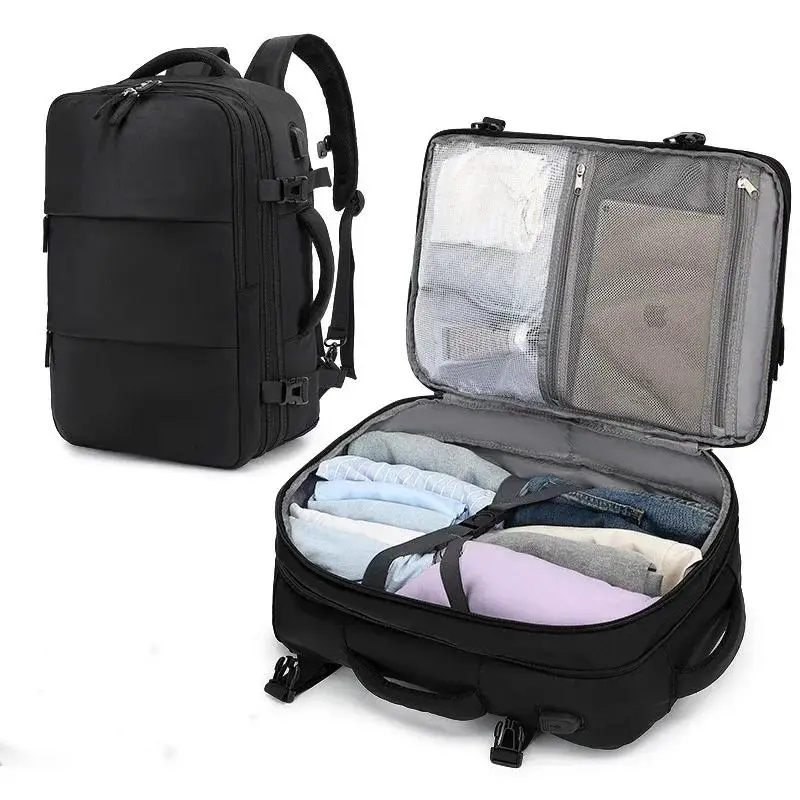
Write the fabric decision into an acceptance specification. A brief that names only the fibre invites substitution, price drift and returns, while a specification that fixes denier, coating weight, abrasion cycles and colour fastness keeps every production run comparable.
A workable specification sheet carries the fields below, each one measurable rather than descriptive.
- Fibre type and denier, per panel if base and body differ
- Fabric weight in gsm, coating included
- Coating or laminate type and add-on weight
- Hydrostatic head in millimetres for any water claim
- Abrasion cycles and test method for high-wear panels
- Colour fastness to light and rubbing
- Recycled content and certification, if claimed
Cost follows the spec. Nylon generally runs 20% to 50% more per metre than equivalent polyester, and the gap widens with specialty weaves, so most programmes reserve nylon for panels the customer touches and specify polyester for linings and secondary pockets. Recycled polyester has mature supply and stable pricing, while recycled nylon depends on waste-stream availability and carries a premium.
Where a range spans several constructions, brief a partner that runs both fibres under one roof, since bag manufacturing services covering sourcing, coating and seam construction remove the mismatch that appears when shell and trim are bought separately.
FAQ
Three questions come up once the specification is agreed, and none of them is settled by the fibre name alone.
How long should a fabric travel bag last?
A well-built 600D polyester bag used for occasional trips typically lasts five to seven years, while a 1000D nylon travel bag in weekly airline service runs eight to ten. The limiting factor is rarely the shell. Zippers, wheel housings, handle anchors and base abrasion decide when a bag is retired, so fitting quality deserves as much attention as fabric choice.
Is recycled polyester good enough for travel bags?
Yes, for most applications. Recycled polyester from post-consumer bottles reaches the same tenacity as virgin fibre when extrusion is controlled, and it is available in the 600D to 900D range used for bag shells. Ask for the recycled content percentage, the certification behind the claim and a shrinkage figure, since inconsistent feedstock causes variation between lots.
Do nylon and polyester travel bags hold odour?
Polyester holds odour longer. Its low moisture regain leaves sweat and oils sitting on the fibre, and the hydrophobic surface gives bacteria an easy film to colonise. Nylon absorbs more moisture and dries slowly, which brings mildew risk instead. Ventilated compartments, removable linings and washes below 30 degrees limit both.