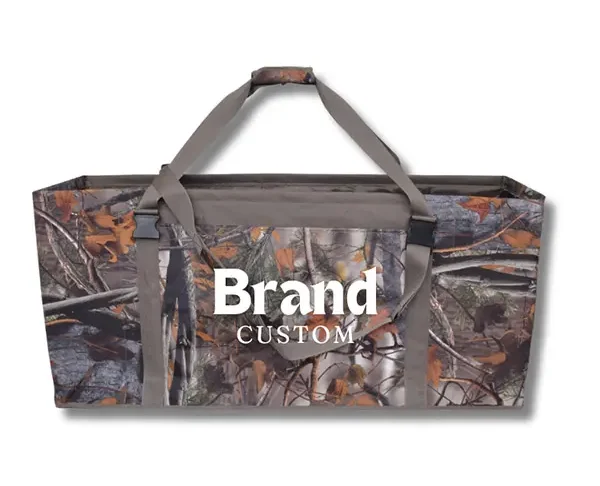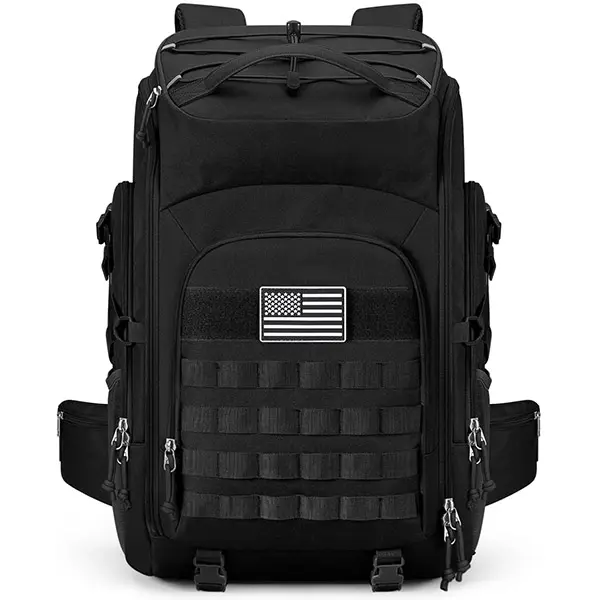
A fishing bag works harder than almost any other piece of outdoor gear. It gets splashed with saltwater, dragged across gravel banks and boat decks, baked in direct sun for entire seasons, and loaded with sharp hooks, wet nets, and heavy tackle boxes. The shell fabric determines how well the bag survives all of this, which is why the fishing bag material you choose matters more than pocket layout or color when you are evaluating quality and long-term value.
There is no single best material for every fishing bag. Nylon offers the best abrasion resistance and tear strength for sewn bags, polyester wins on UV resistance, color retention, and cost, PVC delivers fully waterproof performance at a mid-range price, and TPU provides the best balance of waterproofing, flexibility, and low weight when budget allows. The right choice depends on where and how you fish, and on whether you need a bag that is merely water-resistant or one that is genuinely waterproof.
The sections below break down what each material does well, where each one falls short, and how to match the right fabric to your specific fishing style.
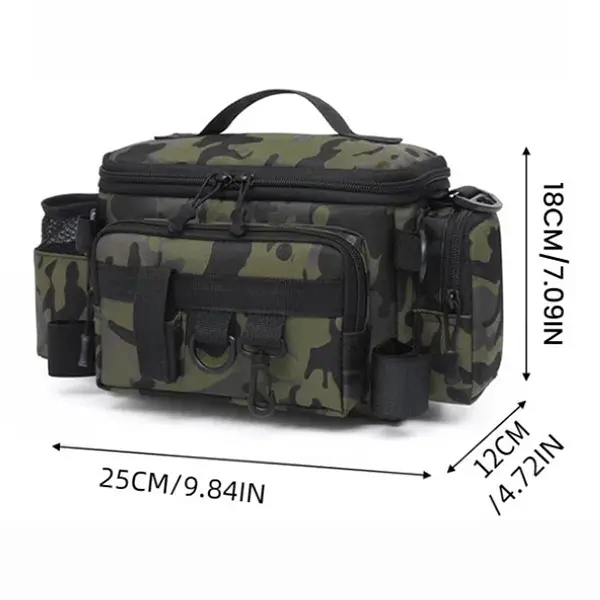
What a Fishing Bag Material Must Withstand
Every fishing bag material is judged on five core properties: water protection, abrasion resistance, UV stability, weight, and cost. No single fabric maximizes all five, so every material choice is a deliberate trade-off among them.
The first thing to understand is that water protection is not a yes or no question. A bag that shrugs off light rain and deck spray is water-resistant, while a bag that keeps gear dry through heavy spray, bilge water, or brief submersion is truly waterproof. The difference comes from both the fabric and the construction: sewn seams leave needle holes that let water in no matter how good the shell fabric is, while welded seams create a continuous barrier with no holes at all.
Beyond water, the material has to survive repeated friction against rocks, dock edges, and non-slip decks. It has to hold up under strong sunlight, because UV radiation slowly breaks down some fibers and coatings. It has to tolerate salt residue and constant wet-dry cycles without stiffening, cracking, or mildewing. And it has to do all of this at a weight and price that makes sense for the product. Buyers planning custom fishing bags for a specific market should map these demands before choosing a shell fabric, because the material decision locks in the entire construction method that follows.
Nylon for Fishing Bags: Strength and Abrasion Resistance
Nylon is the strongest and most abrasion-resistant common fabric for fishing bags. It is the best choice when the bag will carry heavy loads or take rough treatment, as long as it receives a coating for water resistance.
Nylon is a synthetic polyamide fiber known for exceptional tensile strength, elasticity, and resistance to abrasion. These properties make it the default shell fabric for hard-use products such as a fishing tackle backpack, where straps, zippers, and base panels are under constant stress. A high-denier nylon woven in a tight construction can survive years of dragging and scraping that would wear through cheaper fabrics.
Nylon performance is graded by denier, which measures fiber thickness:
- 420D: light chest packs and sling bags where weight matters most
- 600D: the all-purpose standard for most tackle bags and backpacks
- 1000D: heavy-duty bags for saltwater and offshore use
- 1680D: abrasion panels and reinforced base zones only
The main weakness of nylon is water behavior and UV sensitivity. Uncoated nylon absorbs a little more water than polyester and dries more slowly, so nearly all fishing bags made from it carry a polyurethane coating on the inside face. Nylon also loses tensile strength faster than polyester under prolonged sun exposure, which shows up as fading and a powdery surface after a few seasons on a boat deck. For bags sold into high-sun markets, this is the single biggest factor to weigh against nylon’s strength advantage.
Polyester for Fishing Bags: UV Stability and Value
Polyester is the most cost-effective fishing bag material, and it outperforms nylon in UV resistance and water behavior. It is the smart choice for sunny climates and for bags that need dependable performance at an accessible price.
Polyester fiber holds its color and tensile strength far better than nylon under extended sunlight, which is why it dominates bags designed for shoreline, pier, and tropical fishing. It also absorbs very little water and dries quickly, so the fabric itself stays light and resists mildew even after repeated soaking. Colors stay vibrant without expensive dye work, which keeps production costs down.
The trade-off is raw durability. At the same denier, polyester has slightly lower abrasion resistance and tear strength than nylon, so it is more common in entry-level and mid-range products than in premium hard-use bags. In practice, this gap is narrower than spec sheets suggest, because most quality polyester shells use a ripstop weave in which thicker reinforcement threads stop small punctures from spreading into tears. A ripstop polyester in the 600D to 900D range handles normal recreational fishing very well.
Polyester accepts the same polyurethane coatings and DWR surface treatments as nylon, and it laminates cleanly with PVC or TPU films when a fully waterproof build is required. For brands targeting value-driven buyers, a coated polyester shell with reinforced stitching delivers the best performance per dollar in the category.
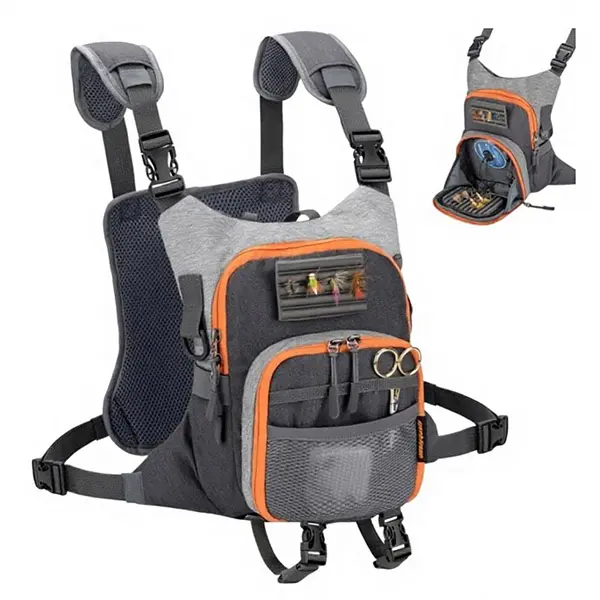
Nylon vs Polyester: Which Is Better for a Fishing Bag?
For heavy loads, rough handling, and maximum durability, nylon is the better material. For sunny conditions, quick drying, and lower cost, polyester is better. The two fabrics are closer than their reputations suggest, and the deciding factor is usually the fishing environment rather than the fabric alone.
| Property | Nylon | Polyester |
| Abrasion resistance | Excellent | Good |
| Tear strength | Higher | Lower |
| UV resistance | Weaker | Strongest |
| Water absorption | Slightly higher | Very low |
| Drying speed | Slower | Faster |
| Relative cost | Higher | Lower |
From a sourcing perspective, polyester typically costs around 8 to 12 percent less than comparable nylon. Many manufacturers choose polyester for bags sold in sunny regions and switch to nylon for bags marketed toward heavy-duty and offshore use. Both fabrics can be built to the same water-resistance level with identical coatings, so the waterproofing question is separate from the fiber choice.
Is 100% Nylon or 100% Polyester Waterproof?
No. In their raw woven form, both 100% nylon and 100% polyester are only water-resistant at best, because the weave leaves tiny gaps between fibers that water can pass through under pressure. A bag described as waterproof must add a coating or laminate, such as polyurethane on the inside, a DWR finish on the outside, or a bonded PVC or TPU film layer, and it must close the seam holes through taping or welding. Any listing that claims a plain woven fabric is fully waterproof without mentioning coatings or sealed seams is using the word loosely.
PVC for Fishing Bags: The Waterproof Workhorse
PVC, meaning polyvinyl chloride laminated onto a polyester base fabric, is the most cost-effective way to build a genuinely waterproof fishing bag. It is heavier and stiffer than the alternatives, but for dry bags, boat bags, and kayak gear, nothing else matches its waterproofing per dollar.
A PVC laminate forms a continuous film over the base fabric, and that film can be joined with radio-frequency welding to create seams as strong as the material itself with zero needle holes. This is the construction behind most dry bags and waterproof deck bags on the market. Typical laminates run 0.5 to 0.7 mm thick, with heavier grades or reinforced double layers used on base panels that take the most abuse. The material also wipes clean easily, which matters when the bag is covered in fish slime, salt, and sand.
PVC has three honest drawbacks. It is the heaviest of the four options, so it is rarely used for full backpack designs where the wearer carries weight all day. It stiffens in freezing temperatures and can crack if flexed hard when very cold. And because it relies on plasticizers to stay flexible, those additives migrate out over several years, which is why old PVC bags eventually turn stiff and crack at fold lines. Specifying a low-temperature grade and avoiding permanent hard folds extends service life considerably.
TPU for Fishing Bags: Premium Waterproofing Without the Weight
TPU, or thermoplastic polyurethane, is the premium waterproof option. It matches or beats PVC on every performance measure while being lighter and more flexible, and its only real disadvantage is cost, which is why it anchors the top of the fishing bag market.
TPU film laminated onto nylon or polyester delivers the same welded-seam waterproofing as PVC but at a significantly lower weight, typically 400 to 650 g/m2 against 550 to 900 g/m2 for comparable PVC builds. It stays flexible down to around -40 C, so roll-top closures keep sealing smoothly in winter conditions where PVC stiffens. It resists abrasion better than PVC at equal weight, and it needs no plasticizers, so it does not grow brittle with age the way PVC does.
That flexibility is what makes TPU the preferred shell for premium designs such as a tactical fishing sling bag, where the bag is folded, compressed, and opened one-handed throughout the day. The material also carries a lighter chemical-compliance burden, since it avoids the plasticizer and stabilizer additives that make PVC documentation heavier.
One technical note matters for buyers: TPU comes in ester and ether grades. Ester grades cost less but slowly degrade in sustained heat and humidity, while ether grades resist this hydrolysis much better at a premium of roughly 25 percent. Any product that will be warehoused in a humid climate before sale should specify the ether grade.
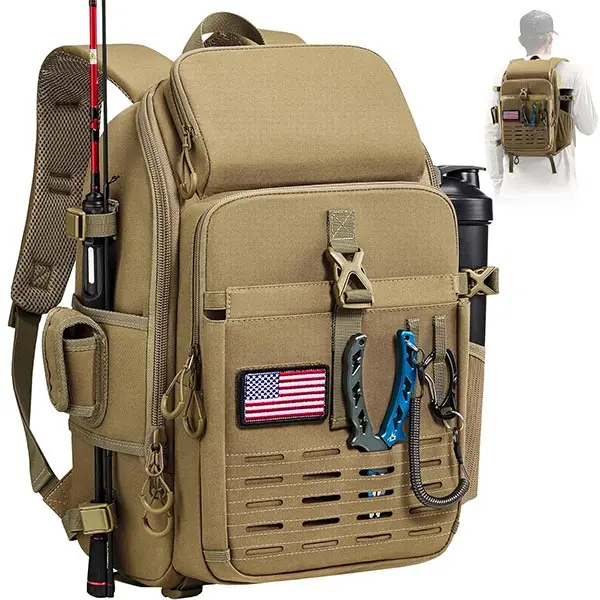
How to Choose: Matching the Material to Your Fishing Style
The best fishing bag material is the one matched to where the bag actually lives during use. Light day fishing points to coated nylon or polyester, boat and kayak fishing points to PVC, and premium all-conditions use points to TPU.
| Material | Waterproof level | Weight | Durability | Best for |
| Nylon with PU coating | Water-resistant | Light | Excellent | Tackle backpacks, heavy loads |
| Polyester with PU coating | Water-resistant | Light | Good | Sunny climates, value models |
| PVC laminate | Fully waterproof | Heavy | Very good | Dry bags, boat and kayak bags |
| TPU laminate | Fully waterproof | Medium | Excellent | Premium waterproof bags |
Mapping materials to real scenarios makes the decision straightforward:
- Shore and bank fishing: a coated polyester or nylon bag handles rain and ground moisture at the lowest cost and weight.
- Boat fishing: a PVC laminate body with a molded or reinforced base survives deck spray, bilge water, and dragging.
- Kayak and wade fishing: fully welded PVC or TPU protects gear through splashes and possible submersion, and a waterproof tactical backpack built on welded film keeps electronics dry.
- Offshore and all-season use: TPU offers the best combination of waterproofing, cold flexibility, and long-term aging.
High-end designs often mix materials rather than choosing one for the whole bag. A common build pairs a coated nylon upper body for weight savings with a PVC or TPU lower band and a molded EVA base where water and abrasion concentrate. This hybrid approach captures most of the performance of a fully welded bag at a fraction of the added cost, which is why it has become standard practice across the mid-range of the market.
FAQs
How long do fishing bag materials last before needing replacement?
A coated nylon or polyester bag typically lasts three to five years of regular use before the coating wears thin at friction points. PVC builds often show stiffening or cracking at fold lines after three to six years as plasticizers migrate. TPU lasts the longest, commonly six years or more, especially in ether grade. Storing bags dry, shaded, and loosely folded roughly doubles these figures.
Can I make an existing nylon fishing bag more waterproof?
Partially. A DWR spray restores beading on the outer face, and a seam sealer applied along inner stitching slows leakage at needle holes, but neither turns a sewn bag into a dry bag. If gear must stay dry through submersion or heavy spray, a welded PVC or TPU liner bag worn inside the pack is the practical upgrade path.
Are welded seams really necessary for freshwater fishing?
For most freshwater bank fishing, no. Coated fabric with taped seams handles rain and morning dew comfortably. Welded seams become necessary when the bag sits in standing water, ships deck spray, or goes near submersion, situations common in boats, kayaks, and float tubes. If your fishing never involves those conditions, paying for welded construction buys durability you will not use.