A laptop bag is the one piece of business travel gear you touch every day of a trip. It goes through the security lane, under the seat in front of you, onto the floor of a taxi, and onto the table before a client meeting. Most of what is sold today as business travel bags is still designed around a forty minute commute, which is why frequent travelers replace a bag every eighteen months and still end up with a strap that cuts into one shoulder.
For frequent business travel, the right laptop bag is the one that matches three variables in order: how far you carry it, how well the device survives a drop, and how fast it clears a security lane. Format follows those answers, not the other way around. A backpack wins on walking-heavy trips, a briefcase wins in front of clients, and a rolling case wins when the total load passes roughly ten percent of your body weight, but none of them works if the laptop compartment is oversized or the empty bag already weighs two kilograms.
The decisions below are ordered so that each one removes options instead of adding preferences.
Six Decisions That Narrow the Field Before You Compare Anything
Work through the six decisions in sequence, because a failure at any one of them makes the rest irrelevant: trip pattern, device fit, security handling, cabin envelope, carried load, and service life.
Most travelers start with appearance or a feature list, then discover three weeks into ownership that the bag fights their actual routine. Answer each question honestly and most of the market eliminates itself.
- Trip pattern. Two or more flights a month with long terminal walks rule out single-shoulder carry. A routine built around cars and client offices keeps a briefcase in play.
- Device fit. Measure the laptop body, not the screen. A bag that fits the device with no clearance will wear the lining and the coating.
- Security handling. Decide whether you hold expedited screening status, because that changes how much a lay-flat compartment is worth to you.
- Cabin envelope. Build to the smallest aircraft you fly, not the largest.
- Carried load. Add the laptop, charger, documents, and a change of clothes before comparing bag weights.
- Service life. Set the number of years you expect, then let materials and hardware do the filtering.
Run the sequence once and the shortlist usually drops to three bags.
Which Bag Format Fits Frequent Business Travel?
There is no single best laptop bag for business travel. The format should follow how far you carry the bag and how formal the room is when you walk in. Backpacks win on walking distance and multi-day loads, briefcases win in front of clients, and rolling cases win when the load is heavy enough to strain a shoulder.
Format is the largest single decision because it fixes everything downstream: how weight reaches your body, how quickly you can open the bag, and how much volume you get for the same footprint. The table below is the trade-off in its shortest form.
| Format | Where it wins | Where it fails |
| Backpack | Long terminal walks, multi-day loads, hands free | Reads casual in formal rooms unless the silhouette is clean |
| Slim briefcase | Client meetings, structured documents | Limited capacity, tiring on long walks |
| Messenger | Quick access while moving, relaxed offices | All weight on one shoulder |
| Rolling case | Loads above eight kilograms, long concourses | Stairs, cobblestones, and crowded trains |
| Sleeve plus tote | Minimal two-day trips focused on digital work | Little protection and no load transfer |
The laptop backpack is where most frequent flyers land, because distance is the variable that punishes you daily. Formality is recoverable through shape and color; a strained shoulder is not.
Size the Compartment to the Device, Not the Screen
Size the laptop compartment against the device body: length, width, and thickness in millimeters, plus a few millimeters of clearance. A compartment that matches the screen size tells you nothing, and an oversized one lets the device shift and strike the bag’s frame during a sudden stop.
Screen size measures the display diagonally, while the body extends beyond it by a bezel and a hinge. Two machines sold as the same class can differ by more than a centimeter in depth. Ask for the internal clearance of the compartment, not the external size of the bag.
Internal Clearance and Marketing Claims
A compartment should hold the device snugly without compressing it. Too tight and the sleeve corners abrade the coating on every insertion; too loose and the device travels several centimeters during braking or a dropped bag. A removable sleeve solves both, because you can carry it alone into a meeting.
Suspension, Foam, and the Second Device
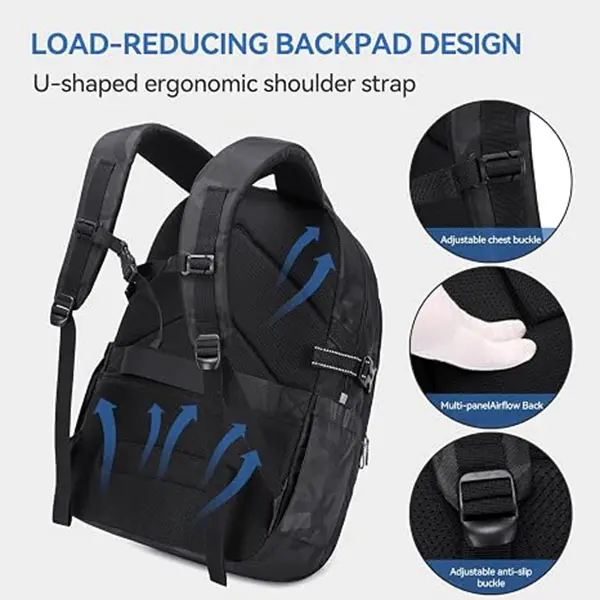
The base is where impact arrives first, so the laptop should hang above it rather than rest on it. Look for at least ten millimeters of closed-cell foam under the base and behind the back panel, a lining that will not polish an anodized finish, and a separate tablet sleeve if you carry two devices. An anti-theft laptop backpack usually combines that suspended compartment with a rear-facing pocket, which is where a passport and a wallet belong in a crowded terminal.
Design for the Security Lane, Not the Boardroom
No bag is certified for airport security, and no design exempts you from the laptop rule in a standard lane. Current TSA guidance states that laptops must come out of the bag and go into a separate bin for X-ray screening, with expedited screening programs as the exception.
That resets the value of a lay-flat design. The benefit is not exemption but handling speed: a laptop bag that opens flat lets you present the device, keep the rest packed, and repack in one motion instead of rebuilding a stack of cables and documents at the end of the belt.
Three construction details make a compartment genuinely flat-opening. The zip must run far enough around the panel to allow a full 180 degree fold, the laptop-facing panel must be free of metal hardware that would obscure the X-ray image, and the same face must not carry a second pocket, since anything stacked over the device defeats the purpose. Packing order matters as much as the bag: put liquids and a belt in an outer pocket, and the laptop compartment stays the only thing you touch.
Carry-On Compliance and the One-Bag Question
Build the bag to the smallest aircraft you fly. IATA’s passenger baggage rules describe a common reference of 56 x 45 x 25 cm including wheels and handles, but cabin allowances remain airline specific, and weight limits usually bite before dimensions do.
A bag measured without its handles can look compliant and still fail a sizer at the gate, so compare packed external dimensions. Weight bites first: the envelope can pass while the packed bag exceeds the cabin limit once a laptop, a charger, and a file folder are inside.
| Constraint | Practical reference |
| Cabin envelope | 56 x 45 x 25 cm including wheels and handles, per IATA |
| Carrier specific | Several carriers publish smaller envelopes close to 55 x 40 x 20 cm |
| Cabin weight | 7 to 10 kg is common on international economy fares |
| Personal item | Smaller still, and must fit under the seat in front of you |
This answers the luggage question frequent travelers keep asking. For a two to three day trip, one bag that satisfies the cabin envelope removes the check-in queue and the risk of a lost device. Beyond that, a matched pair works better: a small laptop bag that slides onto the handle of a rolling case, so the terminal walk costs one hand instead of two.
Load, Straps, and Where Fatigue Comes From
Laptop bag fatigue comes from total weight, strap geometry, and symmetry, not from how thick the padding feels in a showroom. A two-strap bag keeps the load symmetrical, and the useful ceiling sits near ten percent of body weight; above that, a hip belt or wheels do more than any additional foam.
The evidence on asymmetry is consistent. A 2022 review of backpack biomechanics reports higher erector spinae activity on the unloaded side when a bag is worn on one strap, and lower perceived exertion when a hip belt supports the load. Translation for a traveler: a messenger bag is fine for a fifteen minute walk and a poor choice for a two kilometer terminal transfer.
Four numbers decide comfort before you ever put the bag on. Empty weight, because a 1.5 kg bag costs you a tenth of your cabin allowance before packing. Strap width and curvature, because narrow straps concentrate pressure at the collarbone. Back panel depth, because a ventilated panel needs space to work. And adjustability, because a bag that cannot sit high and close to the spine will always pull backward.
Materials and Hardware That Survive Two Hundred Flights
The face fabric is rarely what fails first. On laptop bags used for business travel, the base panel, the main zipper, the handle anchors, and the seams at stress points fail before the shell does, so specify them before you compare denier counts.
Denier measures yarn weight, not abrasion resistance, and a high number on a loose weave can wear faster than a lower one on a tight weave with a good coating. What matters in an overhead bin is puncture resistance at the base, burst strength along the zip, and whether the coating survives flexing at subzero temperatures.
| Element | Failure it prevents |
| Reinforced base panel | Abrasion from repeated placement on concrete and carpet |
| Size 8 or 10 coil zipper | Burst at the curve where the main compartment is fullest |
| Bar-tacked handle anchors | Tear-out when the bag is lifted by one handle fully loaded |
| Double-stitched stress seams | Seam slip at the shoulder strap junction |
| Polyurethane backing on the shell | Coating peel after repeated folding in a bin |
Weight is the tax on all of this. Every reinforcement adds grams, and a bag built for ten years of weekly flights will weigh more empty than a commuter bag of the same volume.
What to Fix in the Spec When You Buy in Volume
Buyers placing a volume order should lock seven items in the written specification, because each one is invisible in a product photo and expensive to correct after production: internal compartment clearance, suspension height, foam thickness and density, zipper size, base material, handle pull strength, and warranty terms with spare parts.
A sample can look right and still fail in service if any of those are left to the factory’s default. Request a dimensioned drawing rather than a photograph, and test a loaded sample by lifting it from one handle and dropping it on a hard floor at the base corner.
- Internal clearance stated in millimeters, with the tolerance
- Suspension height off the base
- Foam thickness and density behind the compartment
- Zipper size, slider type, and whether the tape is water resistant
- Base fabric and its coating weight
- Handle and strap anchor pull strength, tested on a finished bag
- Warranty length, repairable components, and spare part availability
Most of this fits in one paragraph of a specification sheet, which is why the sourcing conversation is worth having early. Working with an OEM bag manufacturer that quotes tolerances rather than adjectives removes the gap between the sample that wins the account and the shipment that keeps it.
FAQ
Three questions come up after the specification is agreed and the shortlist is down to two bags.
Can I leave my laptop inside a checkpoint-friendly bag?
Not in a standard lane, regardless of how the bag is built. If you hold expedited screening status, the device can usually stay packed, so organize the bag around one action: open the laptop compartment, leave everything else closed, and keep an outer pocket for the items that must be removed.
Is a 17 inch bag a problem if I carry a 14 inch device?
It creates two, and both are physical. The device slides within the compartment and loads the sleeve corners on every stop, and the extra volume invites you to fill the bag past the cabin weight limit. If you need that volume for clothing, buy it and add a removable sleeve sized to the smaller device.
Do I still need a laptop bag if I travel with a rolling case?
Only if you leave the case behind during the day. A rolling case protects the device in transit but is awkward in a meeting room and on stairs. The workable pairing is a light sleeve or packable daypack inside the case, which costs almost no volume and covers the hours between hotel and client.