A laptop bag is usually bought on habit rather than specification. A sleeve that rests directly on the base, strap anchors finished with a single line of thread, a main zip with no flap over it: none of these appear in a product photo, yet all of them are settled at the factory, which is why the construction behind a 17 inch laptop daypack can differ so much from a bag that looks identical online. The same effect shows up in pricing, where one bag is sold at four price points through four channels, and the channel you buy from decides what you can inspect, what you can return, and what paperwork arrives with the goods.
You can buy laptop bags from online marketplaces, brand stores, electronics and office supply retailers, luggage specialists, outlet and resale channels, and directly from wholesale or OEM manufacturers. For one or two bags bought on short notice, retail channels are faster and easier to return to. For any order beyond a few dozen units, buying directly from a manufacturer is the only route that gives you specification control, custom branding and verified material documentation.
The sections below compare these channels on the criteria that actually change the outcome, then set out the checks that apply no matter where the order is placed.
Where Can You Buy Laptop Bags?
Laptop bags are sold through six main channel types, and each trades off differently on selection, inspection, price and lead time. Retail channels sell you a finished product code; manufacturing channels sell you a specification, which is why the two are rarely interchangeable for business buyers.
A retail listing answers the question “what is available now,” while a manufacturing order answers “what can be produced to my requirement, by when, with what proof.” Mixing the two expectations is the most common reason bulk orders disappoint.
Online Marketplaces and Brand Stores
Marketplaces offer the widest selection and review volume that surfaces recurring defects quickly, but listing quality varies and many entries quote external dimensions instead of internal compartment size. Brand stores publish consistent spec sheets and honour warranties, at a narrower range and rarely at a discount. Settle the format question before comparing prices, because different types of backpacks distribute load very differently.
Electronics, Office Supply and Department Stores
These stores let you put your own device into the compartment, resolving fit questions in two minutes that no spec sheet can settle. Stock is usually limited to universal 15.6 inch fits, so treat the visit as a fit test rather than a specification exercise.
Luggage and Travel Specialty Retailers
Specialists carry trolley pass-through straps, checkpoint-friendly openings, repair services and replacement hardware as standard. The higher price buys advice and after-sales support rather than better materials.
Outlets, Pre-Owned and Refurbished Channels
Outlet stock is often identical in construction to current models at a lower price. On resale platforms, check strap foam for compression, zipper tape for fraying and base corners for abrasion, and confirm whether the warranty transfers, since it usually does not.
Wholesale, OEM and Custom Manufacturing
This is where business buyers usually end up, and it operates on different logic. You are not selecting from a catalogue; you are locking a bill of materials: fabric and denier, lining, foam density, compartment layout, hardware finish, branding method and packaging. The trade-offs are minimum order quantities, paid sampling rounds, dye lot minimums on custom colours, and a production calendar that has to be booked rather than assumed.
| Channel | Selection | Inspect before buying | Typical unit price | Minimum order | Typical lead time | Best for |
| Online marketplace | Very wide | No | Low to mid | 1 unit | 2 to 7 days | Price comparison, spare or trial bags |
| Brand store | Narrow | Sometimes | Mid to high | 1 unit | 2 to 7 days | Warranty, consistent specification |
| Electronics and office retail | Narrow | Yes | Low to mid | 1 unit | Same day | Urgent replacement, fit confirmation |
| Luggage specialist | Mid | Yes | Mid to high | 1 unit | Same day | Frequent travel, repair support |
| Outlet and resale | Variable | Yes | Low | 1 unit | Same day | Discounted genuine stock |
| Wholesale and OEM | Built to spec | Sample only | Lowest at volume | 100 to 1,000 units | 30 to 60 days | Corporate, retail and private label programs |
What Should You Check Before Buying a Laptop Bag?
Check five things in this order: internal compartment dimensions against the actual chassis of your device, padding structure with a suspended base, material and closure water resistance, the carry system under load, and the hardware. A bag that fails the first two cannot be rescued by price, brand or appearance.
Internal Dimensions, Not Screen Size
Screen size describes a display, not a device. Two 15.6 inch laptops can differ by more than 20 mm in width and by 8 mm in thickness, and a thin bezel model may be smaller than a chunky 14 inch one. Measure width, depth and thickness, then compare against the stated internal compartment size rather than the external bag size. Leave roughly 10 mm of clearance: a compartment that fits exactly compresses the padding until it stops absorbing anything, while a compartment that is far too large lets the device slide and strike the corners.
Padding, Suspended Base and Structure
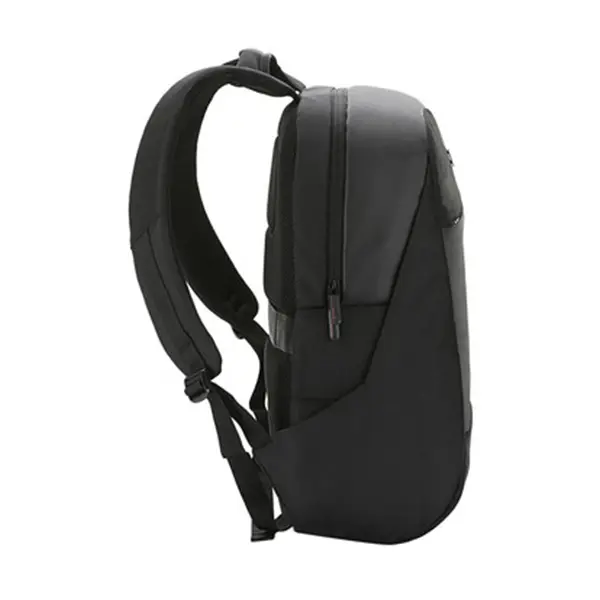
Most damage happens when a bag is set down, not while it is carried, which makes the base the critical zone and the first place low-cost construction cuts corners. A suspended compartment that ends above the base of the bag is the single most effective protective feature at any price point. Confirm that the sleeve closes, since an open sleeve lets the device slide out when the bag is tilted, and check that side walls are structured rather than soft. Access direction is a design decision worth weighing: a compartment that opens against the wearer’s back, as on an anti theft laptop backpack, trades convenience for security in crowded spaces.
Materials and Water Resistance
Material choice sets the ceiling on durability, weight and maintenance, and the trade-offs are consistent enough to compare directly. Denier indicates yarn thickness rather than quality on its own, so read it together with the coating and the weave.
| Material | Weight | Abrasion resistance | Water behaviour | Care | Relative cost |
| Polyester (600D) | Light | Moderate | Water resistant with coating | Machine washable in most cases | Low |
| Nylon (420D to 1680D ballistic) | Light to mid | High | Good, coating dependent | Spot clean | Mid to high |
| Canvas (cotton) | Mid to heavy | Moderate | Absorbs water unless waxed | Spot clean, re-wax | Mid |
| Recycled polyester (rPET) | Light | Moderate to high | Comparable to virgin polyester | Spot clean | Mid |
| Full grain leather | Heavy | High | Resists light rain, stains easily | Condition periodically | High |
Water resistant and waterproof are not synonyms. Coated fabric handles a walk in light rain; it will not survive a sustained downpour, and an uncovered zipper is the entry point regardless of shell quality. A storm flap over the main zip is worth more than a higher denier number.
Carry System and Load Comfort
Strap anchor points fail first, so look for bar-tack stitching or a reinforced patch rather than a single line of thread. Strap width below 50 mm becomes uncomfortable once the bag passes about 5 kg. A firm back panel prevents gear from pressing into the spine, and a luggage pass-through matters more than it sounds if the bag travels with a trolley case.
Organization, Zippers and Hardware
More pockets is not better. Bags with a dozen compartments tend to shrink the main volume and make contents harder to find; two or three well-placed compartments plus a dedicated sleeve is the practical layout. On hardware, check zipper size and smoothness, whether pulls are lockable, and whether sliders are metal or moulded plastic.
| Parameter | What good looks like | Common shortcut |
| Base protection | Compartment ends 15 to 25 mm above the bag base | Sleeve sits directly on the shell |
| Foam | 8 to 12 mm closed cell, density stated by supplier | Thin open cell foam that compresses flat |
| Zipper | Size 8 or 10, covered by a flap | Size 5 with exposed tape |
| Stitching | 7 to 9 stitches per inch, reinforced anchors | 4 to 5 stitches per inch, single line |
| Hardware | Metal D-rings and buckles | Plastic that cracks in cold weather |
How Much Do Laptop Bags Cost?
Retail laptop bags run from roughly USD 30 for a basic sleeve or backpack to several hundred dollars for leather or technical designs, with the practical sweet spot for daily professional use between about USD 80 and USD 200. The gap between tiers is mostly materials, hardware and construction consistency, which is also why volume buyers should cost the specification rather than the shelf price.
What Each Price Tier Actually Buys
Price bands are broad, but the construction differences between them are fairly consistent.
| Tier | Price band | What you get | Where it makes sense |
| Budget | USD 30 to 70 | Basic polyester or nylon, single padded sleeve, standard zippers | Occasional use, students, spare bags |
| Mid range | USD 80 to 200 | Denser fabric, structured base, better zippers, organised interior | Daily commuting, field staff |
| Premium | USD 200 to 350 | Technical fabrics, ergonomic harness, warranty, recycled content options | Frequent travel, client-facing roles |
| Luxury and leather | USD 400 and above | Full grain leather, refined hardware, hand finishing | Executive gifting, long replacement cycles |
Expensive does not automatically mean better protected. Above the mid range you are often paying for material character, finishing and brand position rather than added impact protection, so the value question is whether those attributes serve the way the bag is actually used.
Why the Same Specification Varies in Price
Identical-looking bags diverge on denier and yarn quality, lining weight, foam density, zipper grade, hardware plating, stitch density and quality control sampling rate. Add certification and testing costs, dye lot minimums, packaging, freight terms and channel margin. In bulk sourcing, a 15 percent gap between two quotes almost always traces back to one of these line items, and the quote that omits the breakdown is the one to question.
Is It Better to Buy Online or in Store?
Online is better for selection, price comparison and specification research; in store is better for confirming fit, balance and comfort under load. The practical sequence is to shortlist online and, when the bag is expensive or the daily load is heavy, confirm the final choice in person before committing.
What Only a Physical Store Can Confirm
Loaded balance, real strap pressure on the shoulder, whether the compartment grips your specific device, and how the handle feels with 6 kg inside. These are the failure points behind most returns, and none can be assessed from a product photo.
What to Verify in an Online Listing
Confirm internal dimensions, empty bag weight, warranty terms, the return window and who pays return freight, and whether the laptop compartment is suspended. Read reviews specifically for complaints about zippers, strap anchors and base wear rather than overall star ratings.
Is Buying Online Actually Cheaper?
The sticker price usually is, sometimes by 15 to 30 percent, because marketplaces compress retail margin. That advantage shrinks once return freight, restocking fees and the cost of a wrong choice are counted. For business orders, include freight, duty, inspection and the administrative cost of a replacement shipment, which frequently outweighs a small per-unit saving.
How to Buy Laptop Bags in Bulk for a Business
Buying laptop bags in bulk means buying a locked specification rather than a product listing. The order succeeds or fails on four items: a written specification sheet, an approved pre-production sample, a confirmed production calendar, and documentation that supports the claims you intend to publish. Unit price is the last variable to negotiate, not the first.
Define the Specification Before Requesting Quotes
Quotes are only comparable when the specification is fixed. Settle the size tiers you need (13, 14, 15.6 and 17 inch, or a reduced set), fabric and denier, lining, foam thickness and density, compartment layout, hardware finish, branding area and method, and packaging format, whether polybag, individual carton or retail-ready with hangtag. Working with a laptop backpack manufacturer that already runs your target size tier shortens development, because compartment patterns and foam cutting dies exist rather than being built from zero.
Minimum Order Quantity, Sampling and Lead Times
Minimums depend on material status. Stock fabric and stock colours typically start at a few hundred units; custom dyeing, custom pulls and printed lining push minimums up sharply. Sampling usually takes one to two weeks, production 30 to 45 days after sample approval, and capacity tightens from the third quarter onward as gifting and retail seasons compete for the same lines. Book production slots before the artwork is finalised.
Branding Methods and Their Trade-offs
The method should follow the fabric, not the other way around, because several techniques behave badly on stretch or coated surfaces.
| Method | Works best on | Durability | Setup requirement | Notes |
| Embroidery | Canvas, nylon, fleece | High | Digitised artwork file | Adds texture, less detail on small logos |
| Screen print | Flat panels, polyester | Moderate | One screen per colour | Cheapest at volume, cracks on stretch fabric |
| Heat transfer | Detailed multi-colour artwork | Moderate | Transfer plates | Good gradients, sensitive to abrasion |
| Woven label | Any fabric | High | Woven loom setup | Premium look, adds a sewing step |
| Metal badge | Leather, PU, heavy nylon | Very high | Die and mould | Highest perceived value, longest lead time |
| Embossing | PU and leather | Permanent | Emboss plate | No colour, subtle by design |
Compliance and Documentation to Request
If a bag will be sold or given away with a recycled content claim, the claim needs chain of custody behind it. Under the standards administered by Textile Exchange, recycled content is verified through a scope certificate at the facility level plus a transaction certificate for the specific shipment, and a factory certificate alone does not prove what went into your order. Beyond recycled content, request declarations for restricted substances, azo dyes and phthalates where the bag will be sold into regulated markets, and confirm the inspection standard in writing, including AQL level and whether inspection happens before or after packing.
What a Complete RFQ Should Contain
- Quantity broken down by size, colour and branding variant.
- Target unit price and the Incoterm you are quoting against.
- A specification sheet with fabric, denier, lining, foam, hardware and dimensions.
- Artwork files and the preferred branding method, with placement marked.
- Sample requirement, sample deadline and who bears sample cost.
- Required delivery date, destination port or warehouse, and shipping mode.
- Certificates and test reports required, named specifically rather than generically.
- Inspection and acceptance criteria, including the remedy for a failed inspection.
Suppliers who already run custom programs, such as an OEM bag manufacturer handling private label development, will usually return a specification review alongside the quote, which is a faster way to find gaps than discovering them at the sample stage.
FAQ
The three questions below cover the practical edges of the buying decision that the sections above do not address: minimum quantities, airline allowances and service life.
Can you buy laptop bags without meeting a minimum order quantity?
Yes, but only through retail or resale channels. Manufacturers set minimums because cutting, dyeing and line setup are fixed costs. Buyers testing a design sometimes order a stock model first to validate the format before committing to a custom production run.
Does a laptop bag count as a personal item on a flight?
It depends on the bag’s dimensions and the airline’s allowance, not on the label. A slim sleeve or small backpack often qualifies as a personal item, while a 40L pack usually counts as cabin baggage. Measure the bag against the specific carrier’s published limits rather than relying on product naming.
How long should a laptop bag last with daily use?
Three to five years is realistic for a mid-range bag used five days a week, with the first failures appearing at strap anchors, the base corners and the main zipper. Rotation between two bags, avoiding overloading beyond roughly 8 kg, and cleaning grit out of the base extend service life noticeably.
Meta Description: Compare where to buy laptop bags, from marketplaces and retail stores to wholesale and OEM sourcing, plus the sizing, padding and cost checks that matter.