Flying with a small animal in the cabin has moved from an exception to a routine booking line. Airlines publish under-seat limits, cap animals per flight, charge per kennel and leave the final decision to an agent at the counter. That changes what a bag is: not soft goods, but a compliance item measured against a fixed opening, in public, under time pressure. The margin is narrow. A bag marketed as suitable is often one inch too tall, and that inch is what the agent sees. Buyers sourcing an airline-approved pet travel bag are therefore specifying against a moving target rather than a fixed standard.
Choose a pet travel bag by working backwards from three numbers and four construction details. The numbers are the under-seat limit for the aircraft you are booked on, the exterior your bag actually measures with pockets and handles included, and the standing height of the animal plus two inches. The details are ventilation that keeps working when the bag is compressed, a floor that holds liquid, closures that cannot be nosed open, and a way to fix the bag to the seat. Weight and material decide whether the result is comfortable rather than merely accepted.
The rest of this guide takes those decisions in the order an agent would check them.
What Does Airline Approved Actually Mean for a Pet Travel Bag?
Nothing certifies a pet travel bag. No airline, regulator or industry body issues an approval that travels with the product. Each airline publishes a maximum under-seat size and construction requirements, and an agent decides on the day whether a bag meets them.
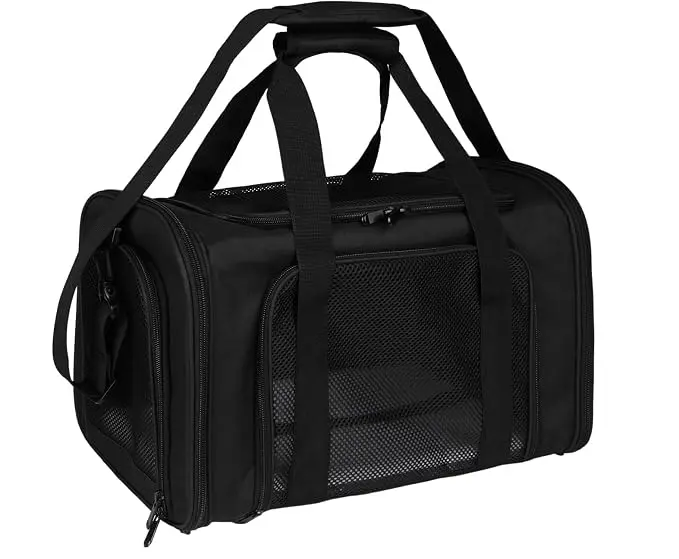
The phrase survives as shorthand. A bag sold this way is normally built around the most common North American limit, roughly 18 x 11 x 11 inches, or 46 x 28 x 28 cm. That figure covers several large carriers but not all, and says nothing about the aircraft you are on. Treat the label as a design dimension, not a permission.
Where the Three Rule Sets Overlap
Three rule sets apply at once.
- The airline sets the maximum exterior size, the ventilation requirement, the combined weight limit and the rule that the animal stays inside for the whole flight, with four-sided ventilation sometimes required on international segments.
- The aviation authority treats the bag as a carry-on item: it must stow under the seat in front without blocking the aisle, and be stowed before the doors close.
- The International Air Transport Association publishes welfare principles for non-rigid containers: room to stand, turn around and lie naturally, ventilation across roughly 16 percent of the four sides combined, and a label that does not cover an opening.
Animals traveling in the hold are a separate product category. A container checked into the hold has to be rigid, with a metal door, fixed dishes and ventilation on three or four sides, as set out in the federal live animal transport rules. No cabin bag satisfies that, and no hold kennel fits under a seat.
What Size Pet Travel Bag Fits Under an Airplane Seat?
Fit is decided by the soft-sided maximum your airline publishes, and among the three dimensions height fails first. A bag that matches the published length and width but stands an inch too tall will not slide under the seat, while a bag that matches all three usually will, provided its top can be pressed down without closing the vents.
These are the limits carriers publish for in-cabin pets. They change without notice, and several are a recommendation rather than a hard rule, so confirm the figure for your route.
| Airline | Soft-sided maximum (in) | Practical note |
| Delta | 18 x 11 x 11 | Recommended figure, varies by aircraft |
| American | 18 x 11 x 11 | Hard-sided 19 x 13 x 9 on mainline |
| United | 18 x 11 x 11 | Hard-sided 17.5 x 12 x 9 |
| Alaska | 17 x 11 x 9.5 | Shortest length on the list |
| JetBlue | 17 x 12.5 x 8.5 | Lowest height, hardest to meet |
Measurement is where buyers lose the argument. Airlines judge the exterior, so measure at the widest point with pockets loaded, handles extended and zipper pulls included, and leave an inch of clearance rather than matching the limit exactly. On a multi-leg itinerary, design to the strictest figure. First rows and exit rows have no under-seat stowage, and a regional aircraft can be an inch or two shallower than the policy page implies.
Measure the Animal Before the Bag
The animal is usually the harder constraint. Measure length from nose tip to tail base with the animal standing, and height from floor to the top of the head or ear tips, then add about two inches to each. The animal must be able to stand, turn around and lie down without its head pressing the roof; a bag that slides under the seat but pins it in a crouch can be refused on welfare grounds. Short-nosed breeds need roughly 10 percent more air, which often pushes them past the limit.
Soft-Sided or Hard-Sided for the Cabin?
A soft-sided pet travel bag wins for cabin travel because it gives about an inch of height under compression, and that inch is usually the difference between a fit and a refusal. A hard-sided carrier only makes sense on an airline that publishes a generous height limit, because a rigid shell cannot flex at all.
Most airlines now recommend soft sides for the cabin, and several accept only soft sides. The hard-sided limits that remain are tighter, and a molded shell that meets them is cramped for anything but a toy breed. The trade-off is protection: a soft bag transmits trolley bumps, while a rigid shell absorbs them. A structured soft bag with a semi-rigid frame is the usual compromise, and it is the format that carries over to a cat carrier backpack worn through a long terminal.
| Aspect | Soft-sided | Hard-sided |
| Under-seat fit | Compresses in height, angles around seat bars | Must match the limit exactly |
| Ventilation under load | Mesh can flatten if the frame is weak | Vents stay open |
| Protection | Limited | High |
Expandable panels must be zipped shut for takeoff and landing, so only the collapsed footprint counts, and a backpack format adds measured depth through its straps and back panel.
Where Bag Weight Eats the Allowance
Cabin limits are usually combined figures: 8 kg on many European and Asian carriers, 10 kg on some, near 20 lb where a North American carrier publishes a number. An empty bag weighing 1.5 to 2.1 kg therefore eats a fifth to a quarter of a European allowance before the animal steps on a scale, and staff do weigh the pair. Cutting 300 to 500 g is realistic with a 210D shell, aluminum rod instead of steel wire, and 8 mm foam instead of 15 mm, though each trades abrasion resistance, frame memory or padding.
Which Cabin Construction Details Decide Acceptance?
Four details of a pet travel bag do most of the work: ventilation that survives compression, a floor that holds liquid, closures that cannot be nosed open, and a way to fix the bag to the seat. Everything else is comfort.
Each of the four can be checked on a sample in under a minute, which is why they belong in the specification rather than the brochure.
Ventilation That Still Works When Compressed
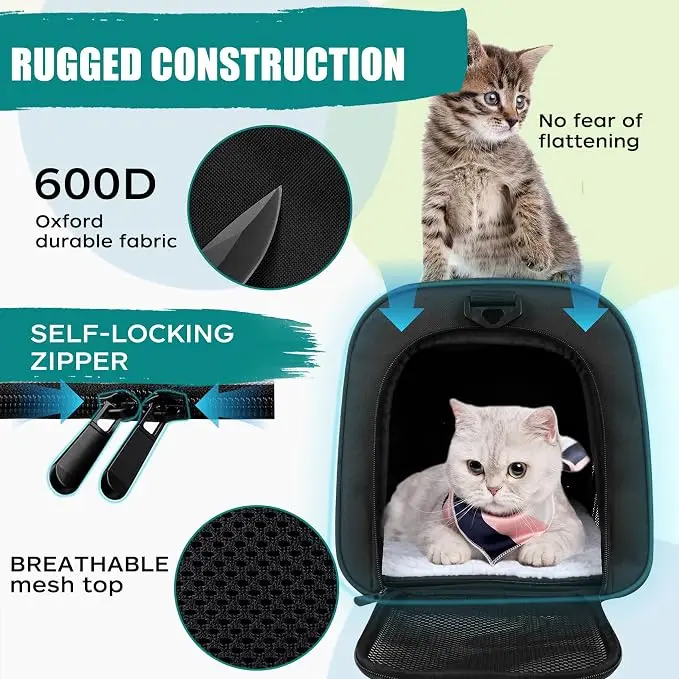
Three ventilated sides is the common minimum, and four sides is required by some carriers on international segments. The same guidance points to ventilated area of roughly 16 percent of the four sides combined, with openings small enough that no paw passes through. The failure mode is not too little mesh but mesh that folds shut under a seat, so each large panel needs a frame member or bound rim behind it. A live-animal label must sit clear of the panels, and a bubble window cuts airflow unless it swaps for mesh.
Floor, Closures and the Escape Points
- The base should be a welded tray with a 25 to 40 mm raised lip and taped seams, so an accident stays in the bag rather than the footwell.
- Closures should be two-way locking sliders, or paired sliders with D-rings that clip together. A single slider on a curved opening is the weak point.
- An interior tether clips to a harness, never a collar, so a bolting animal is stopped without loading its neck.
- A seat belt loop stops it sliding forward during taxi.
Which Materials and Frame Balance Shape and Weight?
In a pet travel bag the shell decides abrasion resistance and water repellency, the mesh decides airflow and tear strength, and the frame decides whether the bag still has usable height after an hour under a seat. Specify all three, because a bag can pass on shell quality and fail on frame memory.
A 420D to 600D plain-weave polyester or nylon is the sensible body fabric for a bag dragged through terminals, and 210D suits weight-critical models. A PU coating in the 800 to 1,500 mm range handles drizzle and spills but is not waterproofing. The two fiber families differ in packability, dry time and cost more than strength, as this comparison of nylon vs polyester travel bags.
| Component | Practical specification | Why it matters |
| Shell | 420D to 600D PU-coated polyester or nylon | Abrasion, stain release, 300 to 500 g total |
| Mesh | 6 to 8 mm polyester honeycomb, bound edges | Airflow with tear resistance at the seams |
| Frame | 3 to 5 mm aluminum rod or spring steel wire | Returns to shape after compression |
| Base | 1.5 to 2 mm PP board in a welded tray | Stops sag, contains spills |
Stitching carries the load paths. Bar-tacks belong at every handle and strap anchor, internal seams should be bound rather than overlocked, and webbing ends turned under. Acetal sliders are adequate except at the main closure, where a metal locking body earns its cost.
How Should the Bag Behave in the Terminal and at Security?
A pet travel bag has to work in three places before it works on the plane: on a shoulder through a long terminal, open on a bench with the animal out, and flat under a seat for the whole flight. The security checkpoint is where bags fail in practice, not at the gate.
At the checkpoint the animal is taken out and carried through the metal detector while the empty bag goes through the X-ray machine. Handlers may run the bag again or swab hands for trace explosives, and a stressed animal can be screened in a private room on request, as the transport security agency’s guidance on pets sets out. Fit the harness and lead before joining the queue, and re-assemble the bag away from the belt. The bag also counts as the carry-on item on most carriers.
What Should Brands Specify When Sourcing Pet Travel Bags?
A purchase order for a pet travel bag that says airline approved specifies nothing. The specification has to state how dimensions are measured, what tolerance applies, how ventilation area is verified and which tests the first article must pass. Those are the four points where a production run drifts from the approved sample.
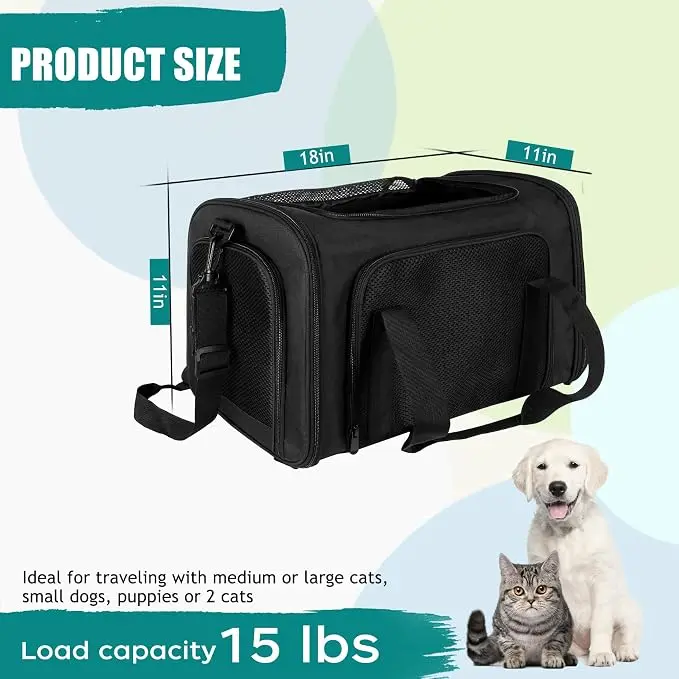
- Define every dimension as exterior at the widest point, pockets loaded, handles compressed, with a tolerance of plus or minus 5 mm on height and width.
- Name the design envelope, for example an 11 inch hard ceiling and a 9.5 inch working height.
- Write ventilation as a percentage of the four sides plus the position of each panel, not as mesh panels.
- Fix the tests: 15 kg static pull on handle and strap anchors, 2,000 cycles on the main zipper, a 30 minute leak test on the base, and a 5 kg load held for four hours with no permanent set in the frame.
- Agree packaging, carton drop height, barcode placement and labeling before the sample is approved, and ask for material declarations plus a factory audit summary.
For a soft carrier, 500 to 1,000 pieces per colorway is a realistic opening order, with a first article in seven to ten days and bulk in 25 to 35 days. An OEM bag manufacturer should show the frame and base construction on the sample, because those two parts decide whether the bag survives its first flight.
FAQ
Three questions tend to arrive once the dimensions are settled.
Can two pets share one pet travel bag?
Only where the airline allows it, and the conditions are tight. The animals usually have to be the same species, of similar size, accustomed to each other and under a combined weight the carrier sets, often around 14 kg. Carriers also cap containers per flight, so the bag needs its own reservation.
How do you clean a bag after an accident?
Unzip every panel, remove the pad and base board, and rinse the tray with cool water and mild detergent rather than solvent. Air dry away from direct heat, because a radiator will distort the frame and shrink the mesh binding. Wipe the coated shell rather than soaking it, and check seams and zipper tape before reassembly.
Is a cabin bag also suitable for the cargo hold?
No. A hold container has to be rigid, with a metal door, externally accessible dishes, ventilation on three or four sides and a live-animal label, and the animal must be able to stand and turn inside it. A soft cabin bag meets none of that. The two formats are also booked differently.