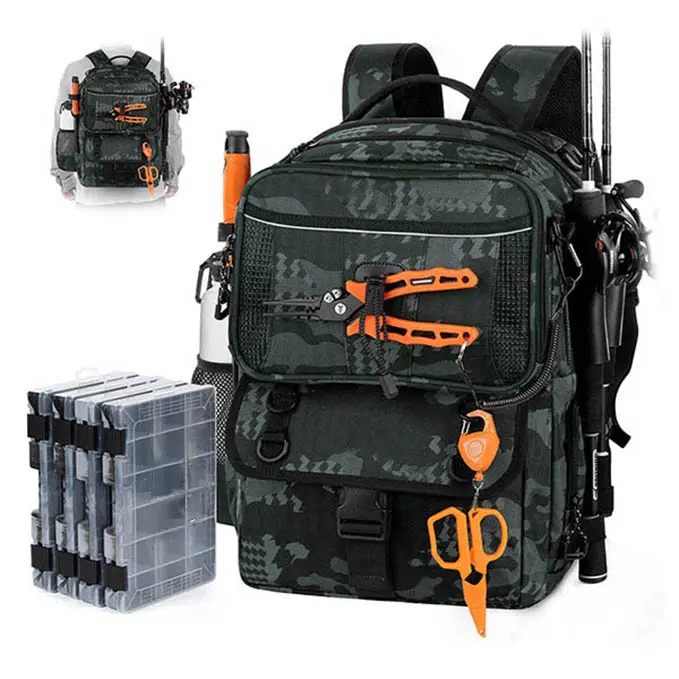
A good fishing bag starts as an afterthought for many anglers, then becomes the difference between a smooth session and a frustrating one. Saltwater spray, shifting tackle, and hours on foot punish poorly chosen gear, and the market is crowded with options that look capable in a product photo but fail at the water’s edge. Whether you wade a surf line, hike to a backcountry lake, or sit bankside for a full day, the bag you carry shapes how much you actually enjoy the trip. A purpose-built fishing bag keeps hooks, trays, and tools organized and reachable instead of buried at the bottom.
A good fishing bag matches your fishing style, your typical load, and the conditions you fish in, then earns its weight through durable fabric, sealed hardware, real waterproofing, and angler-specific organization such as tray storage, rod holders, and drainage. No single feature matters more than fit between the bag and how you actually fish.
The sections below walk through the choices that separate a dependable fishing bag from a regretful purchase.
Start with how you fish, not the shelf
The right bag follows your fishing style and session length, not the color or the review score, because a pack built for a mobile surf caster will frustrate a sit-and-wait bank angler and vice versa.
Fishing bags are not one category. The term covers very different tools, and the first decision is whether you move constantly or settle in one spot. A surf caster who walks a beach for hours needs a different carry than an angler who sets up once and fishes from a chair, and a kayak angler faces different space and water-exposure limits again. The environment you fish in, fresh or salt, moving or static, decides more than any spec sheet.
Plug bags, backpacks, and sling packs compared
Five common forms show up across the category, and each trades capacity for mobility in a different way.
| Bag type | Typical capacity | Best for | Mobility |
|---|---|---|---|
| Plug bag | 5 to 15 L | Active lure casters, quick access to plugs | High, worn at the belt or shoulder |
| Chest pack | 5 to 10 L | Fly fishing, frequent lure changes | High, swings to front |
| Sling pack | 10 to 20 L | Stream wading, mobile fishing | Medium high, swings aside |
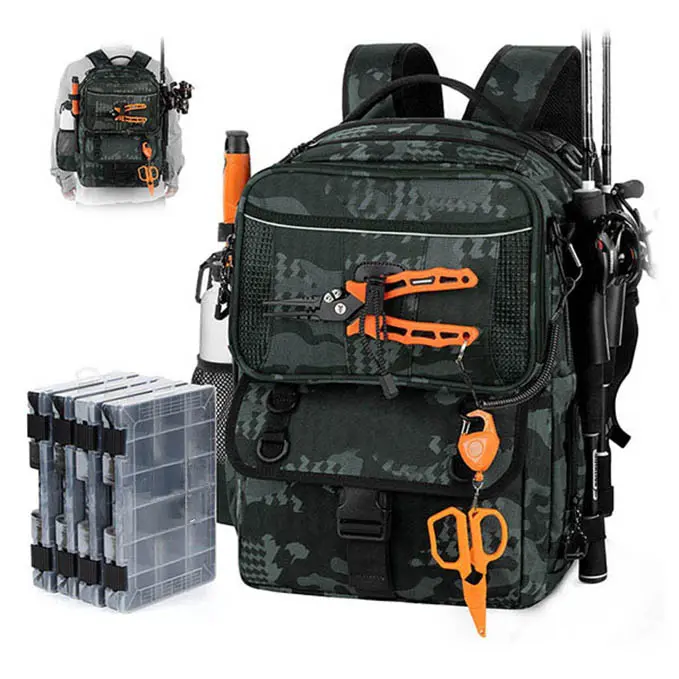
| Tackle backpack | 20 to 35 L | Serious anglers, multiple species | Medium, two-shoulder carry |
| Standard backpack | 30 to 42 L | All-day trips, boat fishing | Lower max storage |
A smaller pack keeps you light and fast, which is why the idea of a fishing bag small enough for a quick session has steady search interest. A larger backpack carries food, layers, and several trays but slows you down. Match the form to the day you fish most often, not to the trip you dream about.
Match capacity to your typical trip
Size the bag to the load you carry on a normal trip, because a pack that is too large tempts overpacking and turns a day of fishing into a weight-training session by mid-afternoon.
Capacity should track how long you stay out and how much gear that demands. A two-hour evening session needs far less than an eight-hour tournament day. The trap is buying the biggest number on the shelf: field testing shows packs over 40 L encourage anglers to haul 35-plus pounds, and that load produces back strain within about two hours. A 20- to 35-L tackle backpack handles three to five standard trays plus a hydration bladder for a full day, which covers most bank and kayak situations.
For short outings, a sling or chest pack in the 5 to 20 L range keeps essentials forward and accessible without a heavy frame. A sensible packing order places the heaviest trays against your back and low in the pack, lighter layers on top, and the items you reach for often in the front pockets. Reserve the largest backpacks for multi-species or all-day trips where the extra volume is genuinely used, and you avoid the top-heavy tilt that pulls your shoulders backward.
Build quality starts with fabric and hardware
Durability lives in the fabric denier, the stitching, and the zippers, because those three points take the abuse of hooks, salt, and sand long before the rest of the bag shows wear.
Saltwater is corrosive and tackle is sharp, so construction matters more than styling. A bag that looks tough can still fail at a seam or a zipper after a season of real use, which is why the build details below deserve a close look before the color does.
Denier and material choices
Denier (D) measures fabric thread thickness, and higher numbers mean a stronger weave, though with added weight. Common choices span the range:
- 600D polyester: entry level for occasional freshwater use, adequate but prone to hook punctures over time.
- 1000D abrasion-resistant nylon: the balanced choice for most anglers, with strong resistance and a reasonable weight.
- 1680D ballistic nylon: maximum durability for guides and heavy saltwater use, heavier by 15 to 20 percent.
- PVC tarpaulin: fully waterproof but less breathable, useful for inshore and wet environments.
A recycled high-denier nylon with a TPU coating is a common 2026 option that balances eco profile, weight, and water resistance, while a durable water repellent finish on the outer face sheds light spray before it soaks in.
Zippers and seams are the failure points
Seams should be double or triple stitched at stress points, with bar tacks at attachment zones where straps and bases meet the body. Zippers are the most common long-term failure, so look for oversized, corrosion-resistant hardware with self-healing coils rather than thin, unnamed slides. In independent reviews of bags used near water, non-branded zippers account for the majority of durability complaints. Spend the construction budget here before spending it on pockets you will never open.
Water protection is a spectrum, not a label
Waterproof is a graded claim, not a switch, so read the protection level instead of the marketing word, because a bag rated for light spray will soak through in heavy rain or a capsize.
The word “waterproof” gets applied loosely, and the real protection runs across a spectrum that buyers should learn to read:
- Water-resistant: a durable water repellent coating and storm flaps; fine for light rain and boat spray.
- Water-repellent: a polyurethane coating with sealed seams; handles moderate rain for an hour or two.
- Waterproof: a TPU lamination with gasket zippers; survives heavy rain and brief immersion.
- Submersible: welded seams with a roll-top closure; built for kayak capsizing and surf exposure.
Some packs reference an IPX rating, where the IP (Ingress Protection) code grades resistance to dust and water on an agreed scale. The International Electrotechnical Commission, which defines that rating system, notes that vague terms like “waterproof” tell you little without a tested level attached (IEC IP ratings). A waterproof fishing bag claim is only meaningful once you know the level and the closure type, not the adjective on the box.
A useful layout is a dedicated dry zone near the top for phones, wallets, and keys, separate from the wet storage below. Even a rated pack can fail if zippers are left open or sand fouls the seals, so keep critical electronics in a secondary dry pouch regardless of the label.
Fishing-specific features that earn their weight
Spend weight on features tied to real fishing tasks, such as tray storage, rod holders, and drainage, and skip decorative loops that clutter the outside without solving a problem.
Generic backpack features do not always help at the water. The details below are the ones anglers reach for repeatedly, and each should earn its ounces against how you actually fish.
Tackle storage and tray compatibility
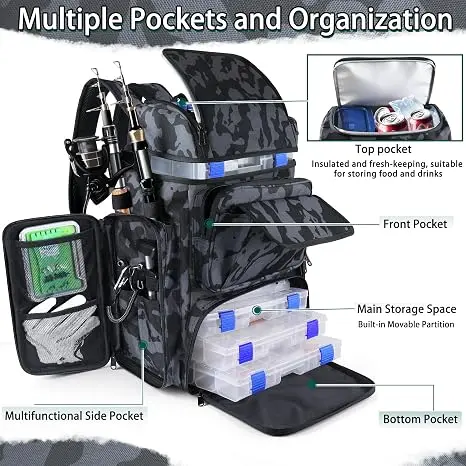
A fishing tackle bag lives or dies by organization. Look for compartments sized for standard tackle trays; the sizes most trays and bag compartments are built around, so you can pre-load lures, hooks, and weights and swap trays by species. External slots for bucktails and a sleeve for pliers keep frequently used gear out of the main compartment. Easy access without unpacking the whole bag is the real test of good layout, not the count of pockets.
Rod holders and hands-free carry
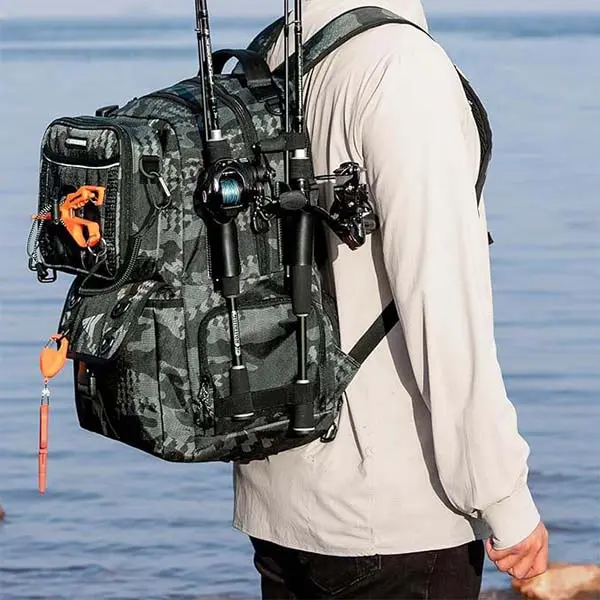
A surf fishing backpack with a rod holder lets you carry a second rod while your hands manage line, bait, or a fish. Side pockets and adjustable straps secure the rod butt and protect the tip from damage during the walk to a spot. For balance, tuck rod butts in diagonally and alternate sides rather than loading both on one shoulder, which creates an uneven pull. A best surf fishing backpack for long beach sessions pairs this with padded straps and a waist belt, because the load gets heavy once trays and water go in.
Drainage, tool loops, and useful extras
Drainage is nearly non-negotiable in saltwater: grommets or a mesh bottom let water escape instead of pooling with your gear. D-rings and webbing loops give a home for pliers, grippers, and a fillet knife. A bag with interior LED lighting helps you find a hook or a drop of leader at dusk without a headlamp in your teeth, a feature worth weighing if you fish in low light. An insulated compartment, as found on a fishing backpack with a cooler, keeps food and catch separated from tackle on a warm day. None of these are required, but each earns its place when your fishing style uses it.
Comfort decides whether you actually carry it
Comfort is the make-or-break factor on a loaded bag, because padded straps and a hip belt move the weight off your shoulders and onto your strongest structure, the hips.
A full bag can weigh 25 to 40 pounds, and poor ergonomics turn productive fishing into endurance testing. The carry system matters more than any logo once the pack is loaded, so judge the straps and frame, not the shelf.
Straps, hip belt, and sternum strap
Shoulder straps should be at least about 2 inches wide with foam cushioning, not flat slabs that concentrate pressure into one line. A padded waist belt transfers roughly 60 to 70 percent of the load from shoulders to hips, which is why packs over 30 L or loads over 20 pounds should not skip it. A sternum strap keeps the shoulders from sliding and stabilizes the load while you move, and load-lifter adjustments pull the pack close to the back so it does not sway.
Back panel ventilation
A suspended mesh back panel creates an air gap that cuts sweat and heat on long carries. Molded lumbar support that conforms to the lower back reduces pressure and improves posture. On hot days and long hikes, ventilation decides whether you still want the bag on your back by hour six, so try the pack on loaded rather than judging it empty.
Test the bag loaded before you commit
Try the bag with real weight before you buy, because an empty pack hides fit problems that only appear once trays, water, and a layer go in.
The store test is the closest thing to a real verdict. Load the candidate with typical gear, water, food, and a layer until it sits near your actual carry weight, then walk stairs and uneven ground. Watch for shoulder hot spots, sway that pulls the pack off your back, and lower-back pressure. If the waist belt slides down while loaded, the fit is wrong, and tightening the shoulder straps only hides it for ten minutes before making it worse. Load, walk, adjust, and repeat until the pattern feels stable, and you will learn more in five minutes than in five minutes of staring at a spec sheet.
Care that keeps a saltwater bag alive
Rinse, dry, and store a saltwater bag correctly, because salt and sand are what actually end its life, not the fish.
After a trip, rinse the bag with fresh water, especially zippers, buckles, and the mesh bottom where grit collects. Open compartments and let it dry fully out of direct sun before storage, since trapped moisture grows mildew and rots stitching. Re-proof the fabric if water starts soaking in rather than beading, and check straps and seams for fraying each season. Store the bag loose, not jammed in a corner, so the frame and seams keep their shape. A bag cared for this way stays organized and ready, which is what makes the next trip easier to start.
Frequently asked questions
What size fishing bag do I need for a day trip?
For a standard all-day bank or boat trip, a 20- to 35-L tackle backpack fits three to five standard trays, a hydration bladder, a rain layer, and tools. A shorter evening session is better served by a 5 to 20 L sling or chest pack that keeps you mobile and unloads fast.
Are fishing backpacks with rod holders worth it for bank fishing?
They are worth it if you walk between spots or carry a spare rod, because the holder keeps the rod secure and your hands free for line and bait. If you fish from one fixed position, a rod holder adds little, and a simpler bag may serve you better and cost less.
How do I keep a fishing bag from molding after saltwater use?
Rinse it with fresh water after every saltwater trip, pay attention to zippers and the mesh bottom, open it up and let it dry completely before storing, and keep it in a cool, dry place. Mildew comes from trapped moisture, so the drying step matters more than the rinse.