A hiking backpack that fits disappears after the first mile. One that does not turn every climb into a negotiation with your shoulders. Most buyers pick a pack by height or by the liter number that sounds safest, then carry a load in the wrong place all day. The rules that decide size take ten minutes to apply, whether you are choosing a pack for a weekend or specifying a hiking bag range for wholesale.
Hiking backpack size comes down to two separate numbers. Capacity, measured in litres, sets how much gear fits and follows trip length: roughly 15 to 30 litres for a day hike, 30 to 50 litres for one to three nights, 50 to 80 litres for three to five nights, and 70 litres or more beyond that. Fit comes from torso length, not height, measured from the bony bump at the base of your neck to the top of your hip bones. Most adults measure 15 to 22 inches (38 to 56 cm), which maps to a frame size from extra small to tall. Capacity decides whether your gear fits; torso length decides whether the weight rides on your hips.
Capacity first, then torso length, because the order matters and almost nobody follows it.
What size hiking backpack do you need?
Buy capacity for the trips you actually take, then match the frame to your torso. A hiker who walks every weekend and camps twice a year is better served by a 25-liter pack plus a 45-liter pack than by one 60-liter pack that stays half empty.
Capacity comes first; fit comes second.
Volume decides whether your shelter, sleeping bag, and food fit, and it comes from a gear list rather than a feeling. Lay out the kit for your longest realistic trip, estimate the space, and add a margin. Buying the pack first and then shopping for gear to fill it is how people end up hauling 65 liters on a four-hour walk.
Size and capacity are two different decisions.
A 60-liter pack is not one product. It comes in two or three frame sizes and sometimes in a fixed and an adjustable version. A third measurement sits alongside them: hip belt size, taken around the top of the hip bones, not the waist.
Backpack size chart by liters: matching volume to your trip
A backpack size chart in liters maps trip length to volume. Half-day walks need 10 to 15 liters, full-day hikes 15 to 30 liters, overnight and weekend trips 30 to 50 liters, multi-day trips 50 to 80 liters, and extended or winter trips 70 liters and up.
| Trip type | Volume | Typical load |
|---|---|---|
| Half-day walk | 10 to 15 L | Water bottle, snack, light shell |
| Full-day hike | 15 to 30 L | Day of food, rain jacket, layers, first-aid kit |
| Overnight to 3 nights | 30 to 50 L | Sleep system, small shelter, food for the trip |
| Multi-day, 3 to 5 nights | 50 to 80 L | Full kit, more food and fuel, bulkier seasonal gear |
| Extended or winter | 70 L and up | Extra food, cold-weather insulation, group gear |
Adjust the chart twice. Cold weather pushes volume up, because insulation and a warmer sleeping bag take more room, while compact gear pulls it down: the same weekend trip needs about 40 liters with a modern kit and closer to 60 with bulkier equipment. The litre figure itself covers the main compartment, the lid, and every pocket, not the space lost to padding and frame, and one litre equals roughly 61 cubic inches.
Day hikes, weekends, and hut-to-hut trips
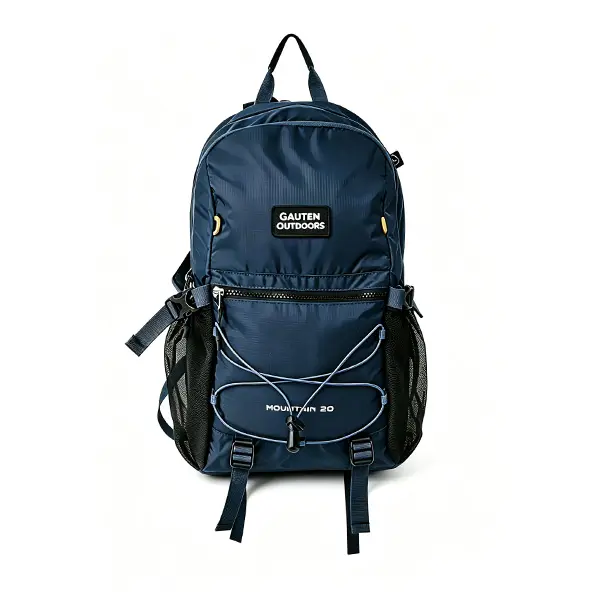
A few hours out is 15 to 20 liters, which is what a 20L outdoor hiking backpack is sized for: water, a snack, a layer, and a first-aid kit, with nothing left over to tempt you into carrying more. Longer or more exposed days push that to 20 to 30 liters. A week away depends on where you sleep: hut-to-hut walking fits in 30 to 45 liters, while camping with your own tent and stove needs 55 to 70 liters. Sizing starts from what you must carry, which makes the Ten Essentials that the U.S. National Park Service recommends a sensible baseline for a day pack.
Backpack torso size chart: measure once, fit every pack
A backpack torso size chart is built on torso length, not height. Measure from the C7 vertebra at the base of your neck down your spine to a line level with the top of your hip bones. Adult torsos usually fall between 15 and 22 inches (38 and 56 cm), and that figure maps to a frame size from extra small to tall.
How to measure torso length at home
All you need is a soft tape measure and someone to read it.
- Tilt your head forward and find the bony bump where your neck meets your shoulders: the C7 vertebra.
- Put your hands on your hips and slide them down until your thumbs find the top edge of your hip bones.
- Have your helper measure down the curve of your spine, from C7 to a line between your thumbs.
- Note the figure in inches and centimeters, then check it against the chart for that pack.
The tape follows the curve of your spine, and your head returns to a natural position before measuring.
Torso length to pack size chart
| Torso (cm) | Torso (in) | Frame size | Typical fit |
|---|---|---|---|
| Under 41 | Under 16 | Extra small | Youth, petite adults, short torsos |
| 41 to 46 | 16 to 18 | Small | Many women and smaller-framed adults |
| 46 to 51 | 18 to 20 | Medium | The most common adult size |
| 51 to 56 | 20 to 22 | Large | Longer torsos and taller adults |
| Over 56 | Over 22 | Tall | Extra-long torsos |
Makers shift these boundaries by an inch or so, so check the chart for the model in front of you.
If you fall between two sizes
Size up. A slightly large pack can be cinched down with compression straps, but nothing stretches a pack that is too short. An adjustable back panel solves it outright, since it spans a whole size range.
Women’s, unisex, and youth sizing
Women’s packs use a shorter torso range, straps shaped to sit around the chest, and a hip belt canted to rest on wider hips. Youth packs add a growing back panel and a movable hip belt, which matters more than capacity, because a young hiker’s torso changes every year.
How to adjust backpack torso length
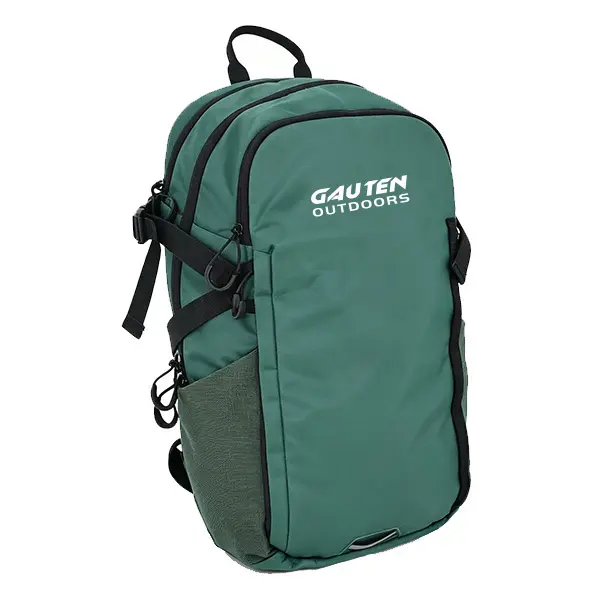
On a pack with an adjustable back panel, torso length is set by moving the point where the shoulder straps meet the frame, usually along a ladder of webbing or a sliding track. The aim is for the shoulder strap anchors to be one to two inches below the tops of your shoulders, while the hip belt stays centered on your hip bones. A fixed-suspension pack cannot be adjusted, so it has to be bought in the right frame size.
Fixed packs are lighter and cheaper because the frame is one piece. Adjustable packs add a little weight and earn it back by covering a whole size range, which suits growing teenagers and anyone whose measurement sits on a boundary.
Setting torso length step by step
- Loosen every strap, including the load lifters and sternum strap, so nothing pulls the pack out of position.
- Load the pack with real weight, roughly 7 to 10 kg.
- Fasten the hip belt and center the padded section on the top edge of your hip bones, not your waist.
- Move the harness until the shoulder straps curve over your shoulders without a gap.
- Tighten the shoulder straps gently, then pull the load lifters to bring the top of the pack against your back.
Walk for a few minutes, because the pack should stay put on its own.
How to wear a hiking backpack properly
Wear a hiking backpack by tightening the hip belt first and the shoulder straps second. The hip belt carries roughly three-quarters to 80 percent of the load, and it belongs on the top edge of your hip bones rather than on your waist. Shoulder straps only hold the pack against your back, load lifters should run out at about 45 degrees, and the sternum strap stays loose enough to breathe.
The hip belt carries the load.
Everything else depends on the hip belt, so set it first and set it snugly. The padded section should wrap the bony shelf at the top of your hips and stay there. A belt that rides up onto your waist sends the weight to your shoulders, and shoulder pain in the first hour usually means exactly that, or a torso length that is too long.
Shoulder straps, load lifters, and the sternum strap
Take up the slack in the shoulder straps by pulling down and back. They should follow your shoulders without digging in and carry very little weight. Load lifters pull the pack closer to your back on rough ground, and a strap sitting at about 45 degrees to the pack body is the usual target. The sternum strap sits just below your collarbones and stops the straps sliding outward.
A five-minute check on the trail
- Hip belt on the hip bones and tight, buckle centered.
- Shoulder straps snug with no gap over the shoulders.
- Load lifters at about 45 degrees, pulling the pack in without lifting it.
- Sternum strap closed and sitting just below the collarbones.
- Compression straps cinched so nothing shifts when you walk.
Backpack dimensions in cm: what the outside measurements tell you
External measurements in centimeters describe the shape of a pack rather than its capacity. Volume is measured inside the main compartment and pockets, while height, width, and depth include the lid, straps, frame, and padding. A pack measuring 55 × 35 × 25 cm has a bounding box of about 48 liters, and usable volume will be lower, so read centimeters as a fit check.
Multiply any pack’s three external dimensions, and you get a rectangular box larger than a real pack bag, because panels are curved, padding takes space, and the lid adds height without adding usable depth. That is why a 30-liter pack can measure taller than a 35-liter pack from another range. Back panel length, though, has to match your torso measurement.
When external size decides a purchase
Travel is where centimeters stop being theoretical. Most airlines publish a maximum cabin bag of roughly 55 × 40 × 20 cm, including wheels, handles, and pockets. A day pack in the 20- to 30-liter range usually fits that envelope, while a multi-day pack rarely does.
How heavy can a hiking backpack be before the size needs to change?
A common working guideline puts a loaded day pack at about 10 percent of body weight and a loaded backpacking pack at about 20 percent. Those are conventions rather than published limits, and what matters more is whether the suspension suits the load.
| Base weight | Pack type | Typical empty pack weight |
|---|---|---|
| Under 10 lb | Frameless | 8 to 16 oz |
| 10 to 20 lb | Ultralight framed | 16 to 32 oz |
| 20 to 30 lb | Lightweight framed | 2 to 3 lb |
| 30 to 40 lb | Traditional internal frame | 3 to 5 lb |
Base weight is everything in the pack minus food, water, and fuel, and those three add up fast: a liter of water weighs a kilogram, and a day of food adds roughly 0.7 to 0.9 kg. Load carriage research on trained carriers, including military studies, puts about 30 percent of body weight at the practical ceiling, with pace, fatigue, and injury rates degrading as the load rises. If your load sits well above what the pack is rated for, the fix is a stronger frame or less gear.
Common sizing mistakes to avoid
The three mistakes behind most discomfort are choosing by height, buying the pack before you own the gear, and oversizing for trips you rarely take. Extra liters on a half-empty pack become a load that shifts and sways with every step.
Height charts feel reassuring because they are easy to read, but two people of the same height can differ by two frame sizes. Buying the pack last, once the shelter, sleep system, and clothing are on the floor, lets you measure the volume you need. Load the pack you are considering with 15 to 20 lb and walk for ten minutes before deciding.
FAQ
Does an empty backpack’s own weight count toward what you carry?
Yes, and on a long trip it can decide whether the day feels comfortable. Empty weights run from 8 ounces for a frameless pack to 5 pounds for a traditional framed pack.
Do children need a different torso size chart?
They fit adult charts, but only up to a point. Children measure under the small end of the adult range, and their torso length grows by several centimeters a year, so an adjustable back panel lasts far longer.
Can torso length change over time?
In adults it stays the same through changes in fitness, weight, and age. Hip circumference changes, and it decides hip belt size, so re-measure that one.